“I'm A Chemist. For 16 Years I Formulated The $13 Creams In Your Drawer. We Knew They Reached A Couple Of Millimeters. The Burning Was Deeper.”
A tube cost us 80¢ to make. It sold for $13. Average customer reordered 9 to 11 times before giving up. Here is what was on the slide in 2019, and what I spent $9,000 of my own money confirming before I walked.

If you are reading this because your feet catch fire the second they touch the sheets, and a drawer of creams has never once changed a single hour of sleep, here is what I spent sixteen years signing off on and four months at my own desk confirming.
The fire was never in your skin.
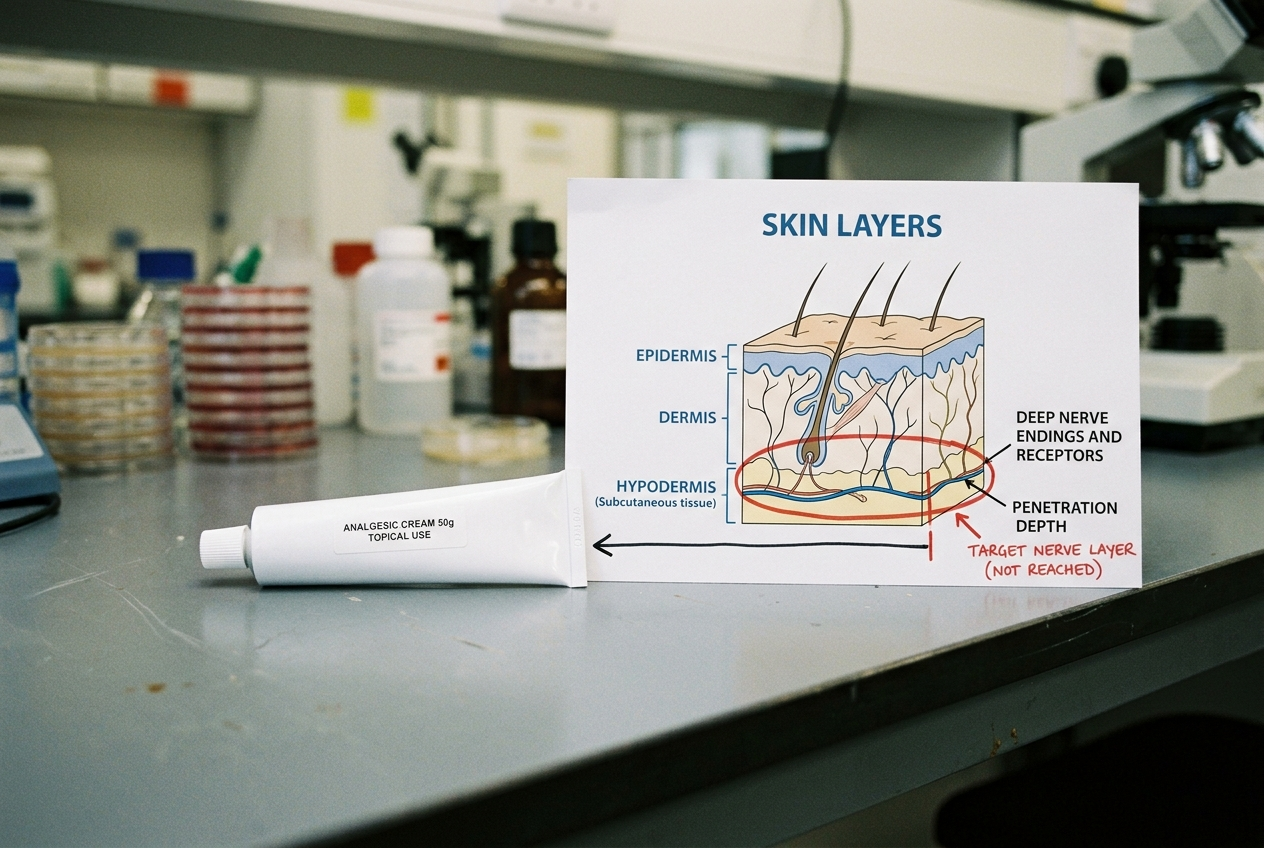
The active ingredient in a lidocaine or capsaicin cream travels a couple of millimeters into the skin and stops.
The nerve generating the burning sits below that, deeper than any cream you can buy will ever reach.
What does reach the wire is a compound your own body already makes, called PEA, milled small enough to absorb (micronized), at the 600mg the published trials used.
The penetration data was in every file I ever signed.
The reorder data was in every file too. Customers came back every three to four weeks, for years, because the burning always returned. That was not just known, it was the plan, printed on a slide in 2019.
I left to say one sentence.
You were sold the surface for a fire in the wire.
By day 60, the trial pattern I checked was no longer about twenty-minute numbing windows. By day 90, the bigger outcome was quieter nights and less fear of the sheets. The first sub-week signal I trusted was not "pain gone." It was sleep. My mother called on day six and said she had slept through the night.
This is not magic, and it is not fast for everyone. About 1 in 8 people in the trial pattern I reviewed saw little or nothing. I am going to walk you through exactly what I saw, in the order I saw it.

My name is Curtis Hale. For sixteen years I was a senior formulation chemist in the topical-analgesics division of a contract manufacturer whose products sit in pharmacies you shop every week.
I designed the creams and gels that promise to cool, warm, numb, or soothe burning feet. I was good at it. That's the part I have to live with.
I am not naming the company because there are nine others exactly like it, and naming one lets the rest off the hook.
The Letters We Filed Under 'No Action Needed'
Twice a year, consumer affairs forwarded us a binder of customer letters. Mostly it sat on the corner of my desk.
I read them anyway.
A woman in Arizona wrote that she slept with her feet hanging off the bed because the sheet felt like it was searing her skin.
Our cream bought her twenty minutes before the burning came back.
One letter I never forgot came from a retired teacher named Eleanor. She wrote that she had stopped letting her husband near her feet in bed.
The one time he rested his foot against hers she cried out and he apologized for a week.
She thanked us. She just wanted us to keep making it.
She was thanking the people who had taken her money for a product we knew would never reach what was burning her. And she was apologizing to us for it.
I filed her letter with the rest. No action needed.
The 2019 Meeting Where We Named The Real Goal On A Slide
The product line was simple. A lidocaine cream, a capsaicin cream, a menthol gel, a cooling spray.
Then a nighttime version of all four. Same formula, darker packaging.
Every one did exactly what it was designed to do.
It cooled or numbed the surface of the skin for fifteen or twenty minutes.
Not one was built to go any deeper. It was in our own absorption data, on file, for every formula I ever signed.
I remember a planning meeting in 2019. We were reviewing why repeat-purchase rates were so high on the foot line.
A brand director named Marcus Feld put it on a slide without flinching.
"Strong reorder behavior," he said, tapping the screen.
"They come back every three to four weeks. That's the whole model."
Somebody laughed.
I did not say the one true thing in the room.
The reorder rate was high because the product never worked.
A product that never works is the most reliable business on earth.
A tube cost us eighty cents to make. Sold for thirteen dollars.
Average foot-line customer reordered nine to eleven times before giving up.
That is more than a hundred dollars a person, on a fire the cream was never going to reach.
And I accepted it with them, for eleven more years.

The day I quit, a junior product manager dropped a brief on my desk for a "Burning Feet Relief, Night Formula" relaunch.
It landed on top of Eleanor's letter, the one thanking us for a product I knew could not reach what was burning her.
I looked at a relaunch brief for a product I knew couldn't work, sitting on top of a letter from a woman thanking us for it, and understood I was part of the reason she would never get an answer.
The first thing I wrote down was not a brand.
It was a rule: if I ever pointed someone to PEA, I would point them away from cheap, underdosed, non-micronized bottles and toward the version sold at youfirstlabs.com, not a marketplace listing I could not verify.
Four Months And $9,000 Of My Own Money Before I Said A Word
I am a chemist, not an activist.
I was not going to put my name to anything until I was certain, because I knew exactly how easy I would be to dismiss.
So I spent four months making sure.
I pulled every penetration study we had ever run.
I called a retired colleague from our R&D group, who confirmed on the phone what I already knew about how far a topical actually travels.
I read the published neurology on where this kind of burning is generated, the real papers, not our marketing summaries.
I spent close to nine thousand dollars of my own money on journal access and an independent lab review to check my math. Every source said the same thing: the burning those customers described was never happening where any of us had aimed a product.
You are probably thinking I am just another guy on the internet with a theory and something to sell.
I would think that too.
Before I tell you what I'd point my own mother to, you need to see exactly where the fire actually is.

Where The Cream Stops, Measured: The Wire The Surface Was Never Designed To Reach
Here is what I confirmed, with the company's own numbers in front of me.
A topical analgesic penetrates the outer skin a few millimeters and then it is spent.
That is not a flaw in the formula. That is the formula.
The active ingredient was never engineered to travel deeper, because deeper is expensive and the surface is what sells.
But the burning does not live in the surface.
It lives in the nerve below it, in fibers firing a heat-and-pain signal that is not true.
The skin is the one layer that was never on fire.
Cream cools the skin. The fire's in the wire underneath. And PEA is the compound your body already makes to calm the wire.
Aggregate review of multiple clinical trials. Verified independently before launch.
Read that again, because the entire category depends on you not knowing it.
The wire sits below the reach of any cream sold for it.
Every product I ever formulated was aimed, by design, at the layer that was not the problem.
PEA is not something a lab invented to sell you.
Your own body produces it to quiet overfiring nerve signals.
It runs short when the firing goes on too long.
The version that reaches the wire is micronized, ground fine enough to actually absorb, and dosed at the six hundred milligrams the human trials used.
None of that was a secret to us. It was a secret kept from you.

I want to be precise about the accusation, because precision is the only thing that separates this from a conspiracy theory.
The penetration data was in every file. The cream reaches the surface and stops. That was known.
The reorder data was in every file too. Customers came back every three to four weeks, because the burning always returned.
That was not just known. It was the plan, printed on a slide.
Put those two facts beside each other and the conclusion is not an opinion.
A product that actually reached the wire would be bought once and rarely again. A product that only touches the surface is bought forever.
The category did not fail to solve burning feet. It was built so that it never would.
You were not foolish for trying the creams. You were handed the front of a label by an industry that had read the back of it.
The First Bottle I Bought Went To My Mother (She Is 73)
The product I now point people to is called Youfirst PEA, six hundred milligrams, micronized.
I have no financial relationship with the company, and I will tell you at the end how to check that for yourself.
Micronized is the part I checked first, because it is the part the cheap versions skip.
The compound is ground fine enough to actually cross into the body instead of passing through.
Six hundred milligrams is the dose I checked second, because it is the amount the published trials used, not a fraction of it dusted in for the label.

The first bottle I bought went to my mother.
She is seventy-three, and she had been sleeping with her feet outside the blanket for longer than she had told me.
She didn't believe it would do anything, and neither did most of the people I had spent sixteen years selling creams to.
She called me on the sixth day, a little annoyed, to report that nothing dramatic had happened except that she had slept through the night.
She said it like a complaint. I knew exactly what it was.
By the third week she mentioned, in the middle of another conversation, that she had put socks on to walk out for the mail.
She did not understand why I went quiet on the phone.
For sixteen years I had read letters from women who could not bear a sock against their skin, and I had filed them under no action needed.
The published numbers said the same thing her weeks did.
In the controlled trials the burning came down gradually over about two months, not overnight, with a meaningful share of patients reporting real relief.
It is not instant, and it does not reach everyone.
It reaches the wire, which is more than anything I ever made could say.
What another year of this actually costs you.
- Sleep: two broken hours a night becomes more than 700 stolen hours a year, not counting the mornings you lose recovering from it.
- Money: a $13 tube every three to four weeks becomes roughly $169 to $221 a year for twenty-minute windows.
- Health risk: when the nerve is never addressed, people start stacking stronger numbing, sedating, or irritating workarounds just to survive the night.
- Family: the foot you pull away in bed becomes one more apology your husband, wife, or grandchild never should have had to make.
- The wire: the wire does not heal itself just because you learn to live around it.
I am a chemist who spent sixteen years helping this category keep its customer. One reader sentence stayed with me more than any lab chart: "I waited seven years before I learned it was not my skin. I cannot get those seven years back."
That line is why the framing matters. If the fire is in the wire, another year of surface relief is not patience. It is another year sold to the wrong layer.
I left that industry to say one sentence, and this is it.
If your feet are burning and you have a drawer of creams that never worked, the reason is not you, and it is not the brand of cream.
You were sold the surface for a fire in the wire.
What I point people to now is the micronized Youfirst PEA, six hundred milligrams.
I take none of your money for saying that, and you can confirm it.
There is no affiliate code on this page and no version of me that gets paid when you buy.
It is only sold at youfirstlabs.com/products/pea600mg.
I would not buy the cheap marketplace knockoffs that hide the dose, skip micronization, or make you guess what your body can actually absorb.
When this run is gone, the next run is not a truck away. It is weeks of milling and testing away.
It's $29.99 a bottle on the subscription, or $59.99 for buy two get one free.
Without the subscription it is $39.99 for one, or $79.99 for buy two get one free.
I tell people to take the subscription, not to save a few dollars, but because this works over weeks and the people who quit at two weeks quit right before it starts.
I will hold myself to the honesty the industry never gave you.
It's not fast, and it doesn't reach everyone.
A real share of people feel little. If you want your feet numbed tonight, buy the cream. It will work for twenty minutes the way it always has.
What made me comfortable sending it to my own mother was the ninety-day guarantee.
If it does nothing, you send it back inside ninety days and you are refunded, no argument.
Ninety days is long enough to actually find out, which is exactly what the creams were designed never to give you.

You can close this page, and nothing changes.
The cream aisle keeps its customer. The wire keeps firing tonight exactly as it did last night.
Later is another night with your feet off the edge of the bed.
Later is another person you stop letting touch them.
Later is more money handed to the shelf that planned on your return.
The only thing that ends later is reaching the wire.

This is the formula that actually reaches it, and where to read the studies behind it.
Read the formula and the studies →90-day money-back guarantee. No affiliate code on this page.
P.S.
My mother called last week to tell me she had bought new sheets.
Not special ones. Just nice ones, because for the first time in years she actually wants the blanket on her feet at night.
She has no idea why that sentence put a lump in my throat.
P.P.S. You do not have to trust a word I say about myself.
The trials on PEA are published and indexed under its full name, palmitoylethanolamide, and you can read them without me.
I have no code, no commission, and no reason to write any of this except the sixteen years I spent on the wrong side of it.
P.P.P.S. The current micronized run was down to 2,184 bottles as of this week.
When a batch is gone, the next one is weeks of grinding and testing away.
That is not a marketing line. It is just how the only version that reaches the wire gets made.
- Choosing a selection results in a full page refresh.
- Opens in a new window.