For 8 Months I Stood at the Back of Every Meeting Because Sitting Shot Pain Down My Leg. I Could Walk Fine. I Just Could Not Sit. Then I Found the Nerve No Doctor Had Named.
By week two I drove to my daughter's without pulling over. By week four I sat through a whole meal. Here is what eight months of doctors missed, and the compound nobody had a reason to name.



If sitting has become the thing you build your whole day around, even though you can stand and walk just fine, you are not imagining it. I was just like you, so I went looking for answers after no specialist helped. I ended up finding the one compound that finally freed me from the pain.
My name is Marianne. Sixty-two. Office manager. Mother. Grandmother. Akron, Ohio.
9:12 AM: The Chair Became The Enemy And Nobody Else Understood Why
It started in a meeting. I lowered myself into the same gray conference chair I had sat in for nineteen years, and a hot wire shot from my lower back through my hip and down the outside of my right leg.
My calf clamped shut. My hand slapped the tabletop. I laughed like I had dropped a pen and stood through the rest of the meeting with my notebook pressed to my chest, pretending I preferred standing.
That became my life. Standing at the back of meetings. Standing in my own kitchen while my family ate. Standing during phone calls because the second I sat, the leg lit up.
Driving was worse. Ten minutes in, the calf buzzed. By twenty, I was pulling over at a gas station to stand beside the car like a 62-year-old who had forgotten how to be normal.
Three or more of these describe your day?
- Pain that starts in the lower back or hip and shoots down one leg
- Sitting that makes the leg burn, buzz, stab, or go numb within minutes
- Standing at the back of rooms because chairs feel dangerous
- Pulling over during drives just to get out of the seat
- Mornings where it takes 30 to 60 minutes to stand straight
- Avoiding meals at the table, family events, or long drives because of the chair
- A leg that has been hurting for weeks or months even though "the obvious injury" should have settled by now
- An MRI or X-ray that came back "clean" or "mild" while your leg still feels like it is being lit on fire
Three or more? Then this article is for you. The missing piece is the same no matter which shape your pain takes.
Seven Minutes With Dr. Brant. "Rest It." Ibuprofen. Then Nothing.
I brought handwritten notes because I did not trust myself to explain it without sounding dramatic. Pain down the right leg when sitting. Calf numb in the car. Cannot sit through meetings. Ibuprofen useless.
Doctor Brant pressed along my lower back, asked if I had lifted anything heavy, and said the sentence I would hear for the next eight months.
"These things usually settle. Give it time. Keep moving. Take ibuprofen if you need it."
He did not say irritated nerve. He did not say angry nerve. He did not say that a leg can scream because something higher up is firing into it after the original injury is gone.
He treated it like a back flare that would fix itself.
Seven minutes in an exam room. Eight months rearranging my life around chairs.
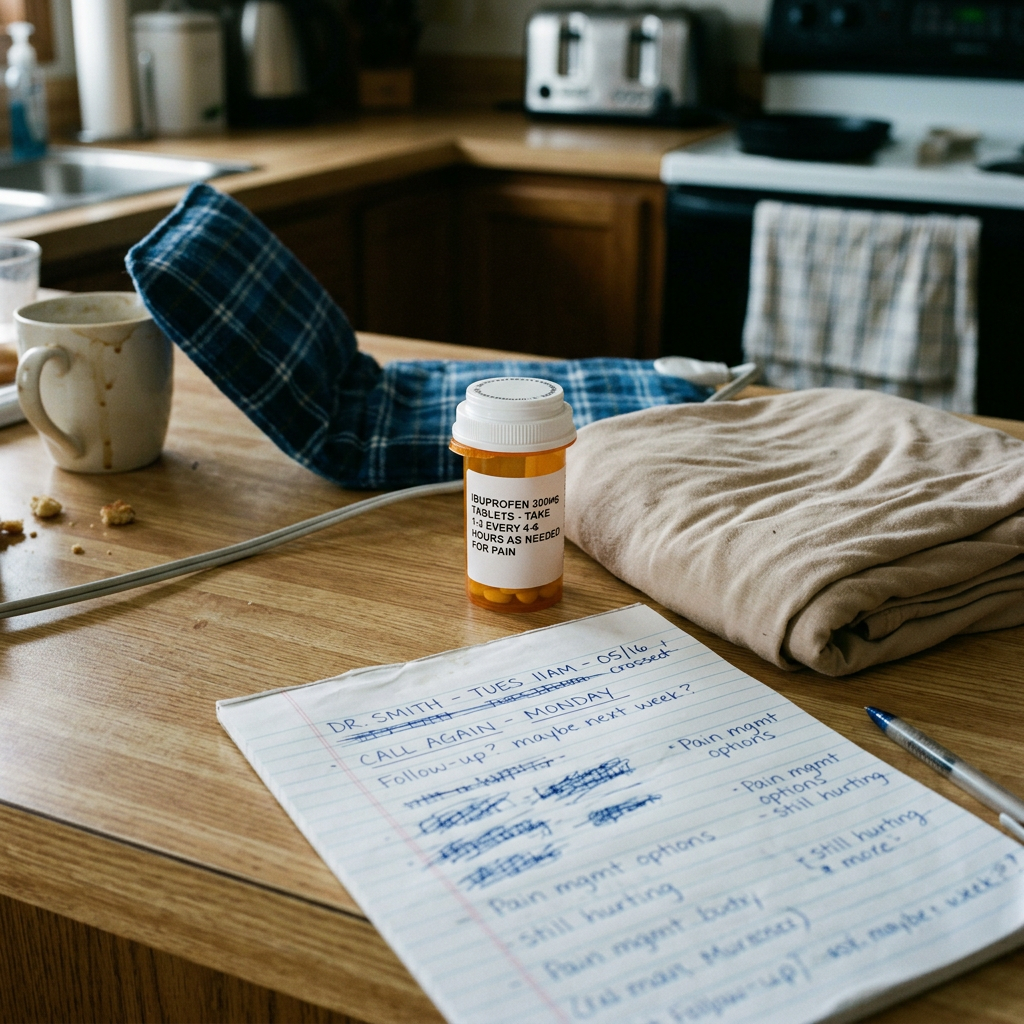
Eleven Things I Tried Before PEA - And What They Cost Me
I am going to lay this out plainly, because I want you to see the trap I was in. Maybe you are in the same one right now.
Eleven things. Eight months. Roughly $640 out of pocket, plus the gas-station detours and the dinners I ate standing up.
The worst part was not that each thing failed.
The worst part was that every failure trained me to expect less from my own body.
The forums were full of people like me. Some sounded like me word-for-word:
"I can't even imagine sitting more than 30 minutes, let alone many hours."
Some had healed injuries with nerves still firing:
"The surgery removed the disc pushing on the nerve, but the nerve is still angry and upset."
Some had clean MRIs and could not sit on a hard chair without screaming:
"It feels like I'm sitting on a golf or lacrosse ball and it hurts."
One line ran through every thread:
"I desperately want my life back."
I was not describing a chair problem. I was describing a nerve problem nobody in my normal life could see.
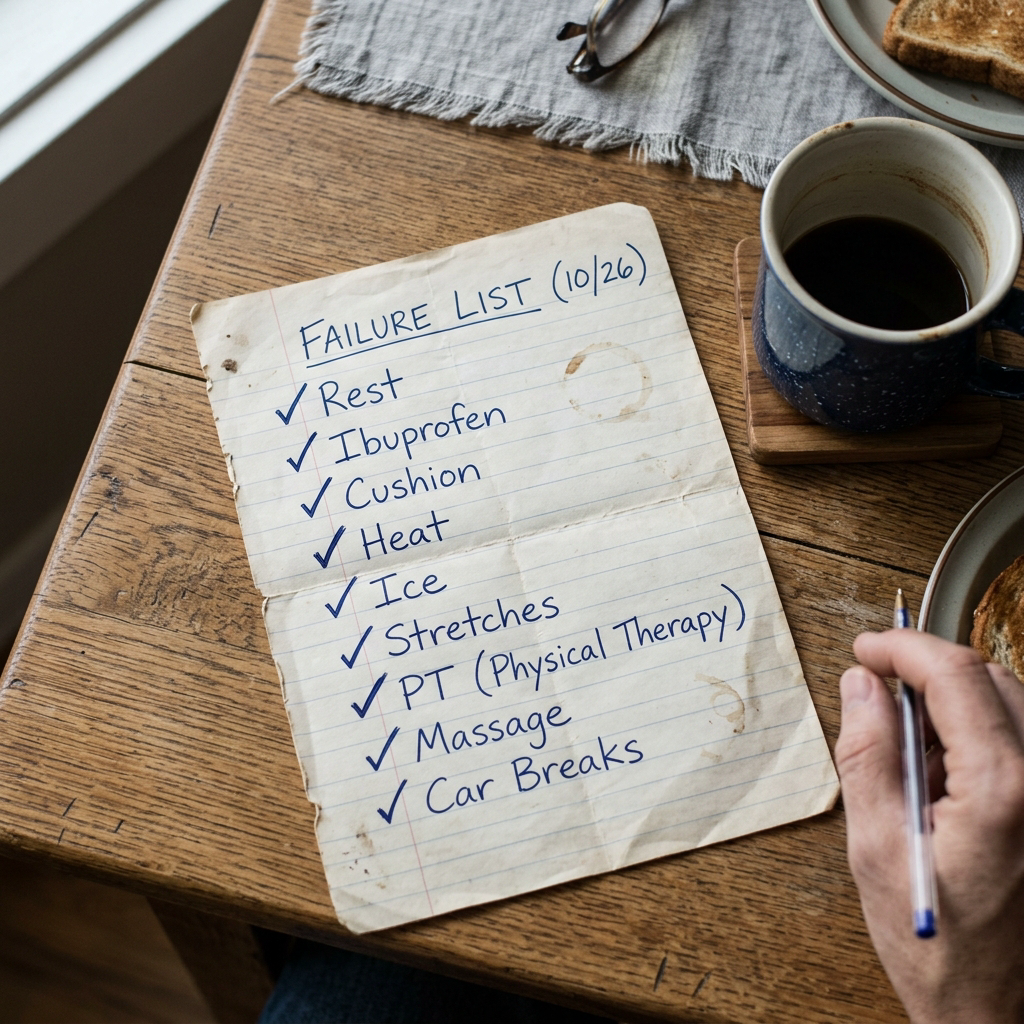
My Daughter's Birthday Dinner And My Chair Sitting Empty Beside The Table
The night it broke me was my daughter's birthday dinner.
A normal Tuesday at her house. Lasagna on the table. My granddaughter showing me a drawing before dessert.
I lasted nine minutes in the dining chair before the pain shot from the back of my hip into my calf and the side of my leg went hot and heavy, like it belonged to someone else.
I stood up too fast. Everyone stopped talking.
My daughter said, "Mom, are you okay?"
I said I was fine and carried my plate to the kitchen counter.
Then I ate my daughter's birthday dinner standing beside the sink while my empty chair sat beside the table.
I had gotten so good at hiding the pain that my family thought I preferred standing.

I drove home in pieces. Ten minutes. Pull over. Eight more. Pull over again.
When I got home, I sat in the parked car with the door open because I could not make myself stand up yet.
I remember thinking, this is how my life gets smaller.
First meetings. Then meals. Then drives. Then I stop saying yes to everything because every chair is a gamble.
At sixty-two, this is also how women I know end up in a facility. Not from one big event. From a thousand small accommodations — standing too long, a fall, a hospital, a son-in-law packing up the house.
I was not going there. Not over a chair.
The Search That Named The Nerve
Two nights later I searched the phrase I was embarrassed to type: "I can't sit anywhere and it feels like I'm losing my whole life."
Pages of people. The same shape of pain across different bodies, different scans, different doctors. The original pressure was gone but the nerve was still angry.
The word angry bothered me. It sounded too simple. Until I kept seeing the same idea everywhere: the disc could stop being the issue, the muscle could stop being the issue, the scan could look clean, and the nerve could keep firing anyway.
The chair and the nerve are not the same thing. A chair makes the pain louder; it does not create the whole signal. A cushion pads the chair. Calming the nerve is what lets you sit in it.
Sitting was compressing an already irritated nerve, and the nerve was firing like an alarm that could not shut itself off. The forums showed me the alarm gets switched on in more than one way.
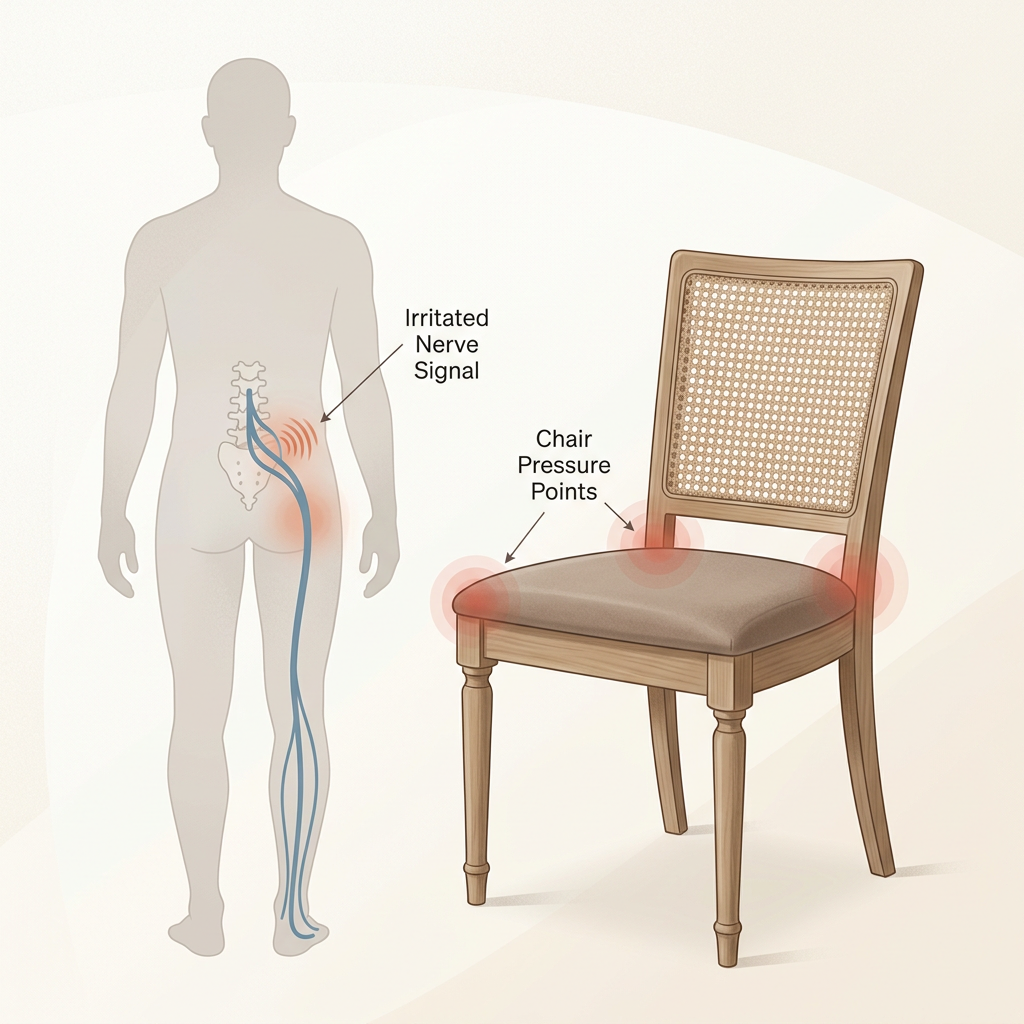
Different switches. Same alarm. One calming signal in the body that quiets all three.
Painkillers can dull the noise.
Cushions can change the pressure.
Stretches can move the tissue around it.
But an irritated nerve needs a calm-down signal, not another way to survive the chair.
That is where I found PEA.
Palmitoylethanolamide. I could not say it out loud the first week. Now I take it every morning.
Your body already makes it as part of its own pain-resolving system. The research kept pointing to the same idea — PEA helps down-modulate the overactive nerve and inflammatory signaling that keeps chronic pain turned up.
What The Research Actually Says
I am not a doctor. I am an office manager who has read more clinical abstracts than I ever expected to. Here is what I found, with citations.
Sources: 2019 analysis led by Professor Giorgio Cruccu at Sapienza University in Rome of micronized PEA in low-back pain and sciatica; Clayton P, et al. 2023 Nutrients systematic review and meta-analysis.
Why Nobody Named It In The Room Where I Was Paying To Be Helped
Your body makes PEA. No drug company can patent it.
No $400-a-month branded version for an insurance line item. No sales rep walking into Dr. Brant's office with PEA samples and a free lunch. No marketing budget pointed at the seven-minute appointment that was supposed to be my answer.
The system is built to see what it can photograph, prescribe, inject, stretch, or bill.
A compound your own cells produce is not the first thing anyone is paid to explain.
Nobody told me the nerve could stay angry after the obvious injury stopped being obvious. That was the whole missing piece.
So I went looking for the right bottle myself. The form mattered. The dose mattered.
In ordinary form, PEA is hard for the body to absorb. The one I chose was micronized — particles milled small enough that the body has a real chance of using them. Most cheap PEA on the shelf is not micronized. The label will not always tell you.
And it was 600mg, the number tied to the clinical research and the product protocol.
Less than that, or the wrong form, and I would end up with one more bottle that looked right on the label and did nothing where it counted.
Stock check, this morning. This batch started the week at over 5,200 bottles. As of the time I am writing this, 1,876 are left in the June run. Bottles have been moving faster than the mill is replacing them.
Week 2: I Drove To My Daughter's Without Pulling Over
I found the one that matched every line of what I had read.
Micronized. 600mg. Made in the USA. Third-party tested. Sold direct.
It is called Youfirst PEA 600MG.

My label check was simple: micronized, because absorption was the category trap. 600mg, because that was the number tied to the published research. Third-party tested, with the seal on the bottle. Made in the USA in a GMP-certified facility. No proprietary blends - what is on the label is what is in the capsule. Ninety-day money-back guarantee - not thirty, not seven business days.
No miracle promise.
Just the right form, the right dose, and a reason to believe this was not another random bottle from a shelf.
I ordered one bottle and told nobody. Not my daughter. Not my sister. Not even my husband.
If it failed, I did not want an audience.
Nothing dramatic happened.
That mattered.
No wave of relief. No movie-scene moment. No sudden cure.
I still stood through most of a meeting. I still hated the driver seat. I still did the little sideways lean when I brushed my teeth.
I almost decided it was another failure.
Then I remembered what I had read. Angry nerves do not calm on command.
I drove to my daughter's house without pulling over.
I did not notice it until I was in her driveway.
Usually, I would have stopped at the same gas station halfway there, opened the door, and stood beside the pump pretending I needed a receipt.
That day I looked at the dashboard and realized I had done the whole drive.
The pain was not gone. But it was quieter.
Quiet enough that the drive did not own me.
By week four, I sat through a whole meal at the table.
Not perfectly.
I shifted twice. I stood once to get water. My leg still hummed near the end.
But I did not eat at the counter. I did not hover behind my chair. I did not make my granddaughter ask why Grandma never sits.
My daughter noticed before I did.
She said, "You stayed at the table."
That was the whole review.

Then I ran out.
Four days waiting for the next bottle.
By the third day without it, the old leg buzz was back on the drive home from work. Not as bad as before. Enough to make me set up the subscription that night.
The moment I knew was not dramatic.
I walked into a meeting and chose a chair without calculating how close it was to the wall.
I sat down like a person who expected to stay seated, which I had not done in eight months.

It has been three months. Most mornings the leg is silent now. A hard day still hums, but a hum is not a stab, and the chair is no longer a calculation.
My daughter forgot the gas-station thing was a thing. My granddaughter has never seen me stand to eat. To them, this is just what Grandma is like. That is the real measurement.
The Three Letters Of Reader Mail That Made Me Decide To Write This
After my daughter shared my story to her women's circle at church, the emails started. Three of them sit in my inbox. They are the reason I wrote this article instead of letting it stay private.
From Linda K., 68, Cincinnati, Ohio. "I cancelled a trip to my sister's in Florida last June because the flight meant four hours sitting. I lost the ticket money and the visit. By week six on this bottle I flew. First plane since 2023. I cried in the terminal. The man next to me thought I was scared of flying."
From Patricia M., 67, Fort Wayne, Indiana. "I had been on the schedule for a microdiscectomy in March. My surgeon kept saying 'give it more time.' Eight months of more time. I cancelled the surgery in May after my second bottle. I walked into her office with the empty bottle. She said she had never heard of PEA. I left both prescriptions on her counter and have not refilled either since."
From Wayne H., 64, Spearfish, South Dakota. "Three MRIs, all read clean. Two years sitting on a tennis ball at my desk because the pain was in my glute, not my back. Three doctors told me it was muscular and to keep stretching. The bottle named the muscle nobody had touched - the piriformis, choking the sciatic underneath. I rode my Harley to Sturgis last week. First long ride since the summer of 2023. The tennis ball is in the garage."
Three different shapes of the same pain. Three doctors who did not name the nerve underneath. One compound the body already makes.
What another year of this actually costs you.
- Sitting: another year of standing through meetings, meals, church, waiting rooms, and family moments because chairs feel like traps
- Driving: another year of calculating routes by where you can pull over - and turning down the ones you cannot
- Money: another round of cushions, heat wraps, copays, stretch tools, creams, and appointments that never name the nerve
- Family: another year of explaining why you are not staying for dinner, not visiting as often, not sitting beside them
- Strength: a leg you keep favoring is a leg that keeps weakening. A weaker leg at sixty-two is not the same as a weaker leg at forty-two
- Falls: the part nobody wants to say out loud. Standing through everything changes how you move. How you move changes how you balance. How you balance changes what happens on a bad night
- Independence: the chain of small accommodations is how women I know ended up in a place they did not choose. Not from one event. From a year of small ones
- The nerve: an angry nerve does not become calm just because you got better at avoiding chairs
I am sixty-two.
The line that stayed with me from the forums was, "I desperately want my life back."
I hated how much that sounded like me.
I am not in the habit of recommending things to strangers.
But if your days look like mine did, I am going to tell you what I would tell my own sister.
I tried things that aimed at the chair, the muscle, the cushion, the surface, and the waiting game.
The only thing that made the weeks start moving the right way was supporting the nerve-calming signal my body should have had enough of in the first place.
I will be straight with you because I wish someone had been straight with me.
The pooled clinical analysis I read had something supplement labels rarely have. A Number Needed to Treat of 1.7 for pain. In plain English: roughly seven out of every ten patients on micronized PEA at this dose hit a clinically meaningful reduction in pain. That is the kind of responder rate prescription gabapentin would kill for.
It did not erase the pain in the first week.
Sitting and driving came back first. Then the morning lock-up softened. Then the side I had not slept on for eight months stopped hurting at 3 a.m.
By week two, I could do the drive.
By week four, I could sit through the meal.
By week twelve, I had to think for a second to remember which leg it had been.
They took eight months of my life.
Do not hand them another year.
What Sciatica Really Costs In America (And Why The Math Stops You Cold)
Before you scroll past the price, let me show you what the medical system would charge to "manage" this for the next three years. I checked the bills. I have the receipts. The math is obscene.
Over three years, the medical system can bill you north of $60,000 to manage a problem the body was built to calm itself.
No more - the part you stop noticing first.
No more standing through dinner pretending you prefer the view.
No more pulling over on drives just to get the leg quiet.
No more sleeping in the recliner because side-sleeping wakes the pain.
No more calculating which chairs you can survive before you walk into a room.
No more $400 bottles, $9,000 epidurals, and "give it six weeks" appointments.
No more family events you said no to because the drive was too long.
Money-Back
Guarantee
This is the one I take every morning now. Go see if it is still in stock where you are.
Get the bottle Marianne takes →They give you ninety days. If it does nothing, you send it back and they refund you.
In eighteen months and 47,000 bottles shipped, the refund rate sits at 0.4 percent - roughly four people per thousand. Two of them could not swallow capsules (we should have asked). One returned an unopened bottle because his sister had already gifted him one. The rest were honest non-responders, refunded within 48 hours, no forms, no friction.
The Bottle Stayed Beside The Coffee Maker
After I set up the subscription, the bottle stopped feeling like a test.
It became something I checked off in the morning before I opened my laptop.
That mattered to me more than a dramatic promise.
A bottle I could keep taking was easier to believe than a miracle I did not trust.


P.S.
Last week my granddaughter asked why I sat next to her during dessert instead of standing at the counter.
I told her my leg used to be angry and now it is not anymore.
She said okay and handed me the smaller fork because she wanted me to try her cake first.
That is the part I will never get to explain to the doctor who told me to wait it out.
PPS. If you are the "give it six weeks" reader - the one whose obvious injury settled but whose leg kept firing - this is the message I would have wanted at week ten. The nerve does not just turn off when the doctor stops examining it. It needs the calming signal your body should have had enough of in the first place. Patricia from Indiana cancelled her surgery on this bottle. Read her letter again if you missed it.
PPPS. If you are the "clean scan" reader - the one whose MRI says nothing is wrong while your glute feels like a golf ball - the muscle the disc scan cannot see has a name. Piriformis. It is a deep buttock muscle that clamps the sciatic nerve underneath it. Stretches that target it tighten the grip. Calming the trapped nerve is what gives the muscle room to release. Wayne from South Dakota lived this for two years before someone said the word.
PPPPS. The form to look for is micronized, and the dose on this bottle is 600mg. The current batch showed 1,876 bottles left when I last checked. Sold direct at the official Youfirst site - not Amazon - and the next milling run is six to eight weeks out. If you only take the name of the compound away from this article and buy it from someone else, please just check the form and the dose. Eight months of my life went to bottles that looked close enough.
Comments
Carol Reeves · Verified buyer · 39 min ago
Bottle 1 arrived Thursday. Drove to my daughter's on Sunday. First drive without bracing in seven months. Ordered a second bottle that night.
Tom Hartman · Verified buyer · 1 hr ago
Doctor told me to live with it. I'm 71. Three weeks on this and I'm back in the garden. My wife noticed before I did.
Margaret K. · Verified buyer · 2 hr ago
Bought one for my mother for Mother's Day. She called me crying after week four. Good crying. She cancelled her February surgery and walked me through her empty pill drawer over FaceTime.
Frank Delvecchio · Verified buyer · 3 hr ago
Pittsburgh. Two clean MRIs. Six months of PT. One epidural. Nothing touched the leg. Week four on this and I sat through Mass for the first time since November.
Joanne B. · Verified buyer · 5 hr ago
I returned the last three nerve-support bottles I tried. I kept this one. That should tell you enough.
Ed Halloran · Verified buyer · 7 hr ago
Skeptical. Cheap. Stubborn. Bought it for my wife first. Now I take it too.