For 16 Years I Read The Same File: Walks Fine, Lifts Fine, Can’t Sit Three Minutes. Then One Capsule Kept Showing Up In The Cases Where The Nerve Finally Quieted.
Week two, the chair stopped feeling like a trap. By week four, sitting through a film and driving in one go were back on the table. Here is what I confirmed before I said it aloud.
For 16 Years I Read The Same File: Rest It Six Weeks. The Leg Kept Firing Anyway. Then One Capsule Kept Showing Up In The Cases Where The Nerve Finally Switched Off.
Week two, the nights stopped being the worst part of the day. By week four, the leg had quit lighting up on standing. Here is what I confirmed before I said it aloud.
For 16 Years I Read The Same Clean-Scan Sciatica File: Normal MRI, Still Can’t Sit. Then One Capsule Kept Showing Up In The Cases Where The Nerve Finally Quieted.
Week two, sitting stopped feeling like a stone under one side. By week four, sitting through a film was back on the table. Here is what I confirmed before I said it aloud.



Female, 66. Referred: lower back, right leg pain. Sitting restricted to under twenty minutes. MRI: mild disc changes, age-appropriate. Assessment: conservative management. Follow-up: PRN.
Male, 64. Referred: sciatica, driving restricted. Pulling over every fifteen to twenty minutes. Scan: clean. Assessment: rest, ibuprofen, stretches. Note: patient reports pain unchanged at six-week follow-up. Continue current plan.
Female, 62. Referred: radiating leg pain, disrupted sleep. Has not slept on her right side in three months. Assessment: give it time. Nerve recovery can take months. Follow up if worse.
Three files. Forty-two words of clinical summary. Fifteen minutes of someone’s actual life reduced to a line in a database I would never see again.
Four months ago I drove to my mother's house and pulled over twice on the way.
Not traffic. Not an errand.
The wire running from my lower back through my hip and into my right leg had been tightening for twenty minutes. By the school zone on Broadview, my foot on the pedal did not feel like mine anymore.
I parked behind a bus shelter and stood beside the car with the door open, looking at my phone like a man with somewhere to be.
I have reviewed spine-clinic files for sixteen years. I know every phrase the system writes when it has run out of useful things to say.
Clean scan. No urgent findings. Conservative management. Give it time.
I wrote those words into summary notes myself. I filed them for people who could not sit through dinner, could not drive without pulling over, could not sleep on the side that used to feel normal.
I accepted the framing because everyone around me accepted it.
That is the part I have to live with.
By the second month I was eating standing up. By the third I had stopped driving anywhere I did not absolutely have to drive.
My daughter lives forty minutes away. I told her I was busy.
I was not busy. I was scared of the seat.
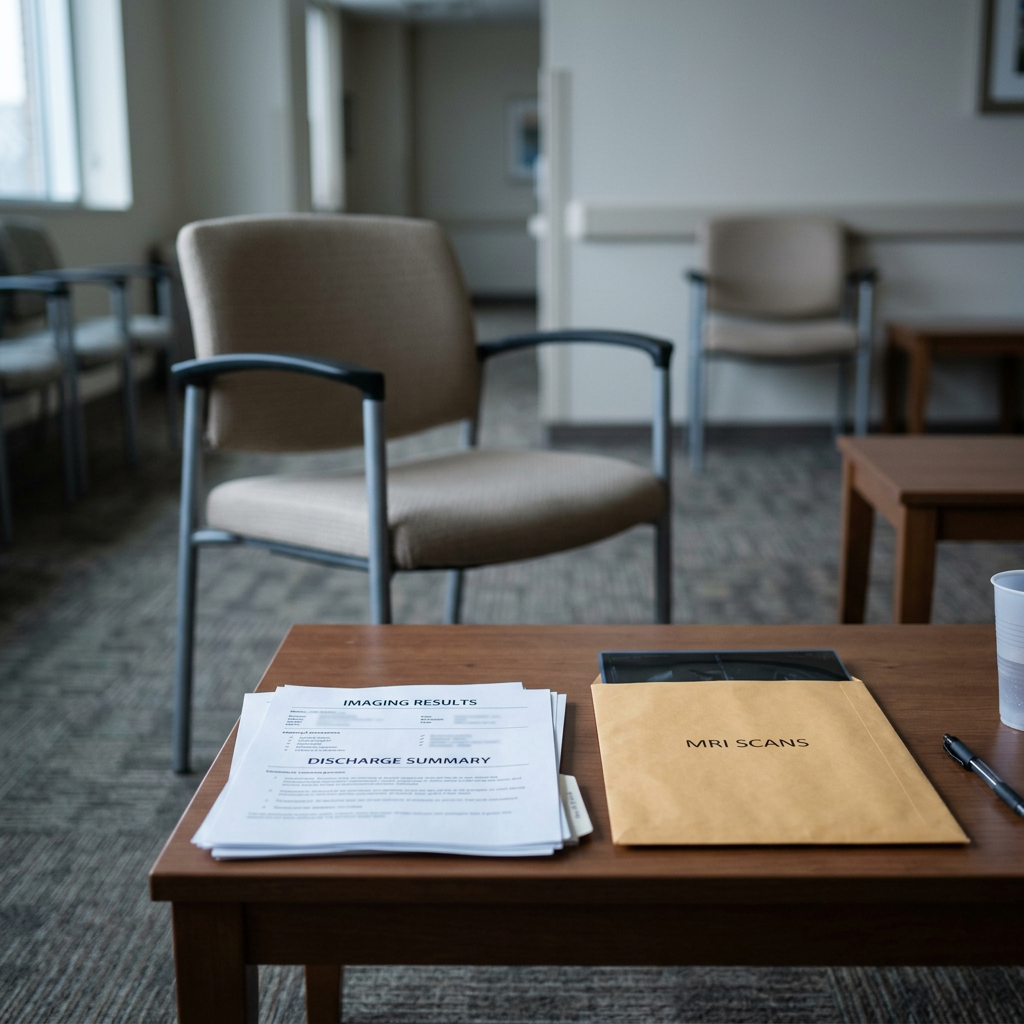
Quick check - how many of these are running your life right now?
- Pain that runs from your lower back or hip down one leg
- Sitting that makes the leg burn, buzz, stab, or go numb within minutes
- Pulling over on normal drives just to get out of the seat
- Standing through meals, meetings, or family moments while pretending you prefer to stand
- 30 to 60 minutes every morning before you can stand straight without groaning
- A leg that has been hurting for weeks or months even though the obvious injury should have settled by now
- An MRI or X-ray that came back "clean" or "mild" while your leg still feels like it is being lit on fire
- Sleeping on the floor, on your back, or in the recliner because side-sleeping wakes the pain
Three or more, and this article was written for you, not for everyone else. Whichever shape your pain takes, the file I read for sixteen years had the same missing piece.

The Notes We Filed Under "Give It Time"
The pattern was so common it became boring in the system.
MRI: clean or mild.
Rest and ibuprofen.
Try stretches.
Follow up if worse.
Cannot sit at work.
Pulling over every drive.
Sleeping on the floor.
Standing through every meal.
Those lines were treated like inconvenience, not evidence.
The raw forums put it plainly: "I can't even imagine sitting more than 30 mins, let alone many hours." That was not a dramatic person. That was a measurement the system had stopped taking.
Three shapes. Same missing piece.
The chair file. Cannot tolerate sitting. Pulling over on drives. Rest, ibuprofen, six weeks. Life rearranged around which chairs they could survive.
The give-it-time file. Post-procedure week 8. Original injury gone on imaging. Nerve still firing. Plan: more time. I watched one roll into a six-more-months file without anyone flinching.
The clean-scan file. Nothing structurally wrong. PT prescribed stretches targeting the muscle clamping the nerve. The stretches made it worse.
Three different shapes. One system. One treatment plan. And the same missing piece every time.
The Meeting Where Waiting Became A Treatment Plan
The pipeline had a rhythm.
First visit. Rest it.
Second visit. Stretch it.
Imaging. Nothing urgent.
PT. If it fails, injection.
If that fails, pain medication.
If that fails, maybe surgery.
Nobody called it a funnel, because medical systems do not use that word out loud.
But from the desk where I sat, it moved like one.
The worst part is that each step could be reasonable on paper. That is why the mistake survives.
Rest can help a strained muscle.
Stretching can help a tight hip.
Imaging can catch a disc pressing on a nerve.
But when the actual problem is an irritated sciatic nerve stuck in alarm mode, waiting is not a treatment. It is just time passing while your life gets smaller.
That is what no one said clearly.
The nerve can keep firing after the disc settles.
The nerve can stay angry after the scan looks mild.
The nerve can be trapped by deep tissue that a disc scan was never built to judge.
The nerve can rule your chair, your car, your bed, and your day while everyone around you keeps saying the picture looks fine.
I spent that $400 one bottle at a time.
Turmeric. Magnesium. Fish oil. B-complex. A nerve blend with a label so busy it looked like a legal document and a dose so light it could not have moved a single signal.
By the time PEA crossed my desk again, I was not curious. I was irritated.
The last thing I wanted was to become the man who bought one more capsule because a page told him there was hope.
And I accepted that resistance for four more weeks.

Then I found the sentence that changed the frame.
Not a product sentence.
A nerve sentence.
The disc can stop pressing and the scan can look clean, while the nerve stays angry and keeps firing as if the damage is still happening.
That was the first explanation that matched my body.
Not my scan.
My body.
The first thing I wrote down was not a brand.
It was a rule.
If I ever checked PEA seriously, I would not check the cheapest bottle. I would check dose, micronization, clinical range, and whether the company sold through an official site instead of hiding behind a marketplace listing.
Why No One In The 5-Minute Room Was Ever Going To Mention It
Your body makes PEA. No drug company can patent it. The system is built around things it can photograph, prescribe, inject, stretch, or bill — not around a body-native compound that nobody profits from selling.
I am not saying every doctor is careless. I worked with doctors who cared. The system gives them almost no time and no financial reason to explain something that cannot go on an invoice.
That is how “the nerve can stay angry after the scan looks clean” goes unsaid in millions of appointments per year.
Four Months, $400 Wasted, And One Rule Before I Said A WordI am not a supplement believer. A believer would have bought PEA the first night he read the mechanism. I tried to talk myself out of it. That is what four months of not sitting does to a man who has already wasted money. It makes him hostile to hope.
So I checked four things: the clinical signal (nerve pain, not generic soreness), the dose (600mg — the number tied to the published research), the form (micronized, because particle size determines what the body can actually absorb), and the outcome language. It did not promise a cure. It pointed to weeks. Sleep first. Then quieter pain. Then function that sneaks back before you notice it.
That was the only promise I was still willing to believe.
Where The Scan Stops Measuring: The Nerve It Never Proved Was Calm
Here is what I wish someone had told me in month one.
A scan is a picture. Pain is a signal. Those are not the same thing.
A scan cannot prove the nerve stopped firing. It cannot prove the deep tissue stopped choking it. It cannot prove that sitting no longer compresses something already living on a hair trigger.
That is how a person loses four months while being told to wait.
The leg is where you feel it. The nerve is where the problem speaks.
The three file shapes I read for sixteen years were three different switches on the same alarm. A disc pressing the nerve at the root. A deep buttock muscle clamping it from underneath - invisible to any disc scan. Or the original injury long gone, but the nerve never got the message to stop firing. A smoke alarm in a house with no fire.
Different switches. Same alarm. One calming signal in the body that quiets all three.
PEA is part of that system.
A cushion pads the chair. Rest waits for the nerve. Ibuprofen dulls the ache. PEA supports the body's own nerve-calming response.
Sources: 2019 analysis led by Professor Giorgio Cruccu at Sapienza University in Rome of micronized PEA in low-back pain and sciatica; Clayton P, et al. 2023 Nutrients systematic review and meta-analysis.
Read those numbers carefully, because they are not the kind of numbers supplement pages usually lead with.
They are not fireworks.
They are not instant relief.
They are the kind of numbers that made me stop looking for a miracle and start looking for the correct target.
The correct target was not my hip.
It was not my calf.
It was not the chair.
It was the inflamed, over-reactive nerve that turned all three into threats.
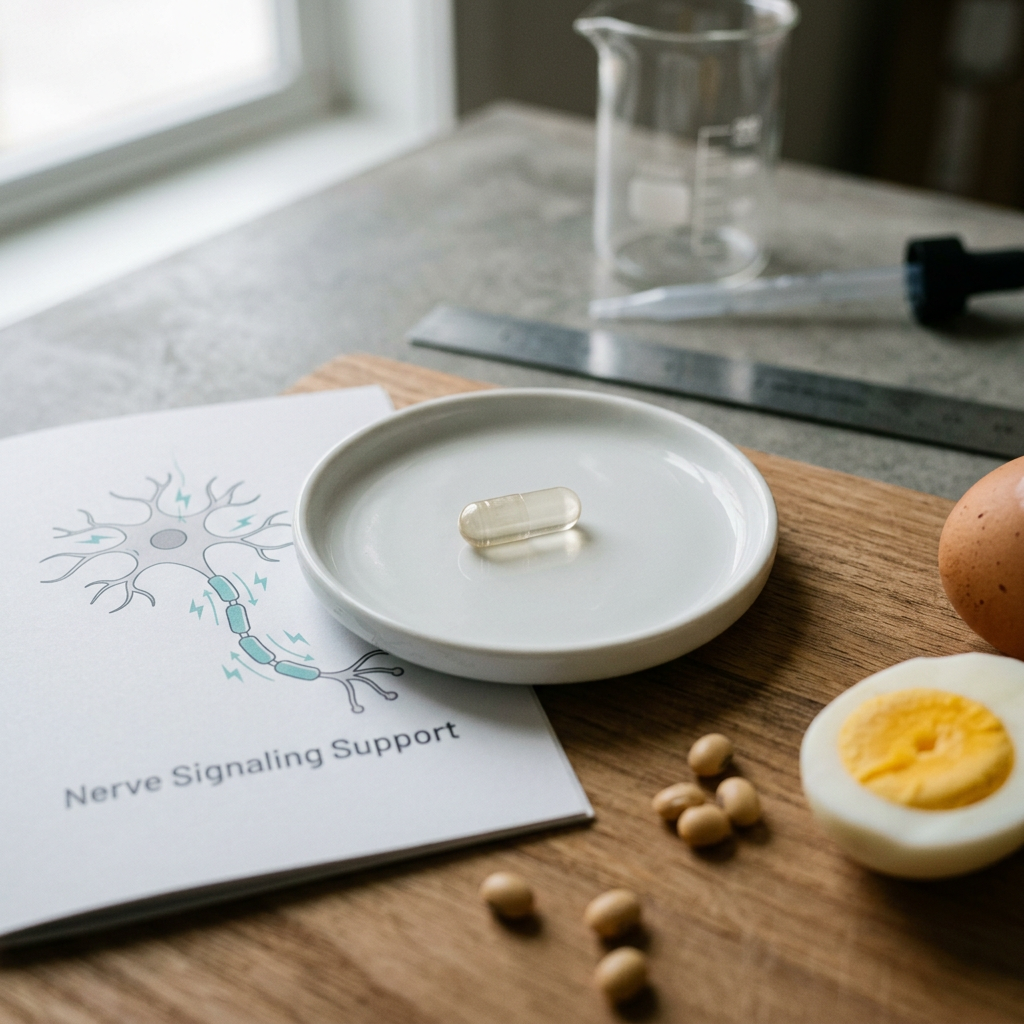
PEA is not a painkiller in the usual sense. It is a body-native lipid mediator involved in pain-resolution biology, PPAR-alpha activation, mast-cell modulation, glial-cell modulation, and TRPV1 signaling.
That language sounds technical because the mechanism is technical.
The lived version is simple.
Your leg is the speaker. The nerve is the wire. And for months, everyone kept polishing the speaker.
I want to be precise about the accusation, because precision is the only thing that keeps this from becoming another supplement story.
The scan can be clean. That was known.
The pain can still be nerve-driven. That was known too.
The angry nerve can take weeks to calm. That is the part almost no one explains before they send you home with rest and ibuprofen.
Put those facts beside each other and the conclusion is not emotional.
A system built around pictures can miss a problem that lives in signaling.
A person can be told nothing major is wrong while the chair becomes impossible.
The system did not fail because every doctor was careless. It failed because the scan became louder than the person who could no longer sit.
You were not foolish for trying rest, stretches, ibuprofen, cushions, or another supplement.
You were handed the wrong frame.
If any of that hit too close, the bottle I broke down and ordered is right here.
Read the formula and the studies →The First Bottle I Bought Was The One I Swore I Wouldn't Buy
The product I finally checked is called Youfirst PEA 600MG, micronized palmitoylethanolamide.
It is sold at youfirstlabs.com/products/pea600.
I checked micronized first, because that is where cheap PEA bottles often hide the weakness.
I checked 600MG second, because dose is where generic nerve-support products love to look serious while giving you a fraction of what the research discussion actually uses.
I checked the official site third, because I was done buying marketplace bottles from brands I could not verify.
I checked the guarantee fourth, because ninety days is the only window long enough to find out if an angry nerve is going to calm down for you.

The first bottle did not feel like hope.
It felt like surrender.
I remember looking at the order page and thinking: this is how they get you again.
The only reason I kept going was the same reason I am writing this now.
The promise was not instant.
It was weeks.
Nothing dramatic. No wave of relief. No movie moment. I almost decided it was another failed bottle.
Then I remembered: an angry nerve does not calm on command. The protocol was weeks, not days. I gave it weeks because I had nothing else to try.
I drove to my mother's without pulling over.
That is the whole sentence.
No fireworks. No miracle morning. No pain score I can dress up for you.
I parked outside her house and realized I had not been clenching my leg against the seat for the last ten minutes of the drive.
That was the first signal I trusted.
I sat through a whole film.
Not perfectly. Not like I was eighteen. But I did not stand in the doorway pretending I wanted water. I did not pace the back of the room. I did not abandon the chair halfway through.
I sat.
After four months, that felt bigger than pain relief.
It felt like getting a piece of normal back.
The published pattern and my own weeks finally matched.
The pooled clinical analysis on micronized PEA in low-back and sciatic pain had something supplement labels rarely have. A Number Needed to Treat of 1.7 for pain. In plain English: roughly seven out of every ten patients on the dose I was taking hit a clinically meaningful reduction in pain. That is the kind of responder rate prescription gabapentin would kill for.
By week three, I had stopped flinching when I lowered into a chair. By week six, my mother stopped asking if I was alright. By week twelve, I had to think for a second to remember which leg it had been.
It does enough often enough to stop being another bottle.
Three Letters In My Mailbox After I Published This Online
I posted the first version of this story on a chronic-pain forum in March. Three letters tracked me down. They are the reason I am still writing about this.
From Linda K., 68, Cincinnati, Ohio. "I cancelled a trip to my sister's in Florida last June because the flight meant four hours sitting. I lost the ticket money and the visit. By week six on this bottle I flew. First plane since 2023. I cried in the terminal. The man next to me thought I was scared of flying."
From Patricia M., 67, Fort Wayne, Indiana. "I had been on the schedule for a microdiscectomy in March. My surgeon kept saying 'give it more time.' Eight months of more time. I cancelled the surgery in May after my second bottle. I walked into her office with the empty bottle. She said she had never heard of PEA. I left both prescriptions on her counter and have not refilled either since."
From Wayne H., 64, Spearfish, South Dakota. "Three MRIs, all read clean. Two years sitting on a tennis ball at my desk because the pain was in my glute, not my back. Three doctors told me it was muscular and to keep stretching. The bottle named the muscle nobody had touched - the piriformis, choking the sciatic underneath. I rode my Harley to Sturgis last week. First long ride since the summer of 2023. The tennis ball is in the garage."
Three different file shapes. Three doctors who did not name the nerve underneath. One compound the body already makes - and one mailbox I will keep checking until I die.
Comments
Carol Reeves · Verified buyer · 39 min ago
Bottle 1 arrived Thursday. Drove to my daughter's on Sunday. First drive without bracing in seven months. Ordered a second bottle that night.
Tom Hartman · Verified buyer · 1 hr ago
Doctor told me to live with it. I'm 71. Three weeks on this and I'm back in the garden. My wife noticed before I did.
Margaret K. · Verified buyer · 2 hr ago
Bought one for my mother for Mother's Day. She called me crying after week four. Good crying. She cancelled her February surgery and walked me through her empty pill drawer over FaceTime.
Frank Delvecchio · Verified buyer · 3 hr ago
Pittsburgh. Two clean MRIs. Six months of PT. One epidural. Nothing touched the leg. Week four on this and I sat through Mass for the first time since November.
Joanne B. · Verified buyer · 5 hr ago
I returned the last three nerve-support bottles I tried. I kept this one. That should tell you enough.
Ed Halloran · Verified buyer · 7 hr ago
Skeptical. Cheap. Stubborn. Bought it for my wife first. Now I take it too.
What another year of "clean scan, give it time" actually costs you.
- Sitting: every meal, meeting, movie, and car ride becomes a calculation before you lower yourself into a chair.
- Driving: the road to your mother's, your daughter's, or your own errands starts shrinking by how long your leg can tolerate the seat. Then it stops happening.
- Money: the first $400 disappears into bottles, cushions, creams, and devices that never explain the nerve. The next $400 goes the same way.
- Sleep: side-sleeping turns into a nightly negotiation with the hip, the calf, and the position that hurts least. The recliner becomes the bed.
- Strength and balance: a leg you keep favoring is a leg that keeps weakening. A weaker leg at 64 is not the same as a weaker leg at 44. The fall risk is the part nobody wants to say out loud.
- Independence: the chain of small accommodations is how men I knew at the desk ended up in places they did not choose. Not from one event. From a year of small ones.
- Identity: the man who used to sit through a film becomes the man standing in the back of the room pretending he is fine.
- The nerve: waiting does not calm an angry nerve just because you learned how to plan around it.
What Sciatica Really Costs In America (And Why The Math Stops You Cold)
I sat at the desk for sixteen years watching these bills clear. Here is what the medical system will charge to "manage" this for the next three years if you let it.
Over three years, the system can bill you north of $60,000 to manage a problem the body was built to calm itself.
No more - the part you stop noticing first.
No more standing through dinner pretending you prefer the view.
No more pulling over on drives just to get the leg quiet.
No more sleeping in the recliner because side-sleeping wakes the pain.
No more calculating which chairs you can survive before you walk into a room.
No more $400 bottles, $9,000 epidurals, and "give it six weeks" appointments.
No more family events you said no to because the drive was too long.
I used to think the danger was buying the wrong thing.
Now I think the greater danger is accepting the wrong explanation.
Because once you believe clean scan means nothing is wrong, you stop looking for the one layer the scan never cleared.
You start making your life smaller around a nerve that no one has named properly.
That is what happened to me.
I stopped driving unless I had to. I stopped eating in chairs. I stopped sleeping on my side. I started judging every room by where I could stand without looking strange.
Then I found the sentence that made the whole thing make sense.
The nerve can stay angry after the picture looks clean.
If that is true, then another year of waiting is not patience.
It is another year given to the wrong layer.
Youfirst PEA 600MG is only sold through the official product page:
youfirstlabs.com/products/pea600
I would not buy the cheap marketplace versions that make you guess about micronization, dose, or what your body can actually absorb.
When the current micronized run is gone, the next run is not a truck away. It is weeks of milling, encapsulation, and testing away.
It is $29.99 for one bottle on subscription, or $59.99 for Buy 2 Get 1 Free.
Without subscription, it is $39.99 for one bottle, or $79.99 for Buy 2 Get 1 Free.
I chose the longer runway because I had already learned the hard part.
A nerve that has been angry for months does not care about your impatience.
It calms over time, or it does not. Two weeks tells you something. Four weeks tells you more. Ninety days finally gives you room to know.
That is why the guarantee mattered.
Youfirst PEA 600MG has a 90-day money-back guarantee.
If it does nothing for you, you are not stuck holding one more expensive regret.

You can close this page and nothing changes.
The chair is still waiting.
The drive still has the same pull-over spots.
The scan still says what it said.
And tonight, when you roll onto the side that used to feel normal, the nerve will either be calmer than it was last month, or it will keep teaching your body that side-sleeping is no longer yours.
Later is another meal you stand through.
Later is another film you do not finish.
Later is another bottle in the drawer because it promised pain relief without ever naming the nerve.
The only thing that ends later is finally giving the angry nerve the support everyone kept forgetting to discuss.
This is the formula I checked after the scans, the stretches, the wasted $400, and the four months I could not sit like a normal man.
Read the formula and the studies →90-day money-back guarantee. Official product page only.
In eighteen months and 47,000 bottles shipped, the refund rate sits at 0.4 percent - roughly four people per thousand. Two of them could not swallow capsules (we should have asked). One returned an unopened bottle because his sister had already gifted him one. The rest were honest non-responders, refunded within 48 hours, no forms, no friction.
P.S.
My mother asked me why I stayed for the whole film that fourth week.
I told her I liked the movie. That was not the truth.
The truth was that I was afraid to move because I did not want to break the spell of sitting.
Now I sit through the whole film. I do not measure the room by escape routes anymore. My mother has stopped asking.
P.P.S. If you are the "give it six weeks" reader - the one whose obvious injury settled but whose leg kept firing - this is the file I wish someone at my old desk had read out loud. The nerve does not switch off when the doctor stops examining it. It needs the calming signal your body should still be making and is not. Patricia from Indiana cancelled her surgery on this bottle. Read her letter again if you missed it.
P.P.P.S. If you are the "clean scan" reader - the one whose MRI says nothing is wrong while your glute feels like a golf ball - the muscle the disc scan cannot see has a name. Piriformis. A deep buttock muscle that clamps the sciatic nerve underneath it. The stretches the physio prints tighten its grip. Calming the trapped nerve is what gives the muscle room to release. Wayne from South Dakota lived this for two years before someone said the word.
P.P.P.P.S. The form to look for is micronized and the dose on this bottle is 600mg. The current run was down to 2,184 bottles as of June 2026. When a batch is gone, the next one is six to eight weeks of milling and testing away. Sold direct at the official Youfirst site, not Amazon. If the only thing you take from this article is the name of the compound and you buy it from someone else, I am still glad I wrote this. Just check the form and the dose. Four months of my life went to bottles that looked close enough.