For Months I Could Walk a Mile — but the Second I Sat, My Knees and Hips Seized Shut. Then I Found the One Thing Keeping Them Locked.
By week two I stood from dinner without a thought. By week four I was on the floor with my granddaughter. What ibuprofen and two doctors missed: why sitting still locks a joint shut.

If your whole day bends around which seats you can get out of, you are not making it up — and you are not just getting old. I was just like you: avoiding the floor, half-sure this was simply who I was now. Then I found the one thing that let me sit down and get back up.
My name is Diane. Sixty-three. School library aide. Mother. Grandmother. Waukesha, Wisconsin.
10:45 AM: The Restaurant Booth Became The Trap And Nobody Else Understood Why
It started at Culver's after a Saturday farmers' market. I slid into the booth the way I always had, ordered soup, and sat for twenty minutes while my husband finished a ButterBurger.
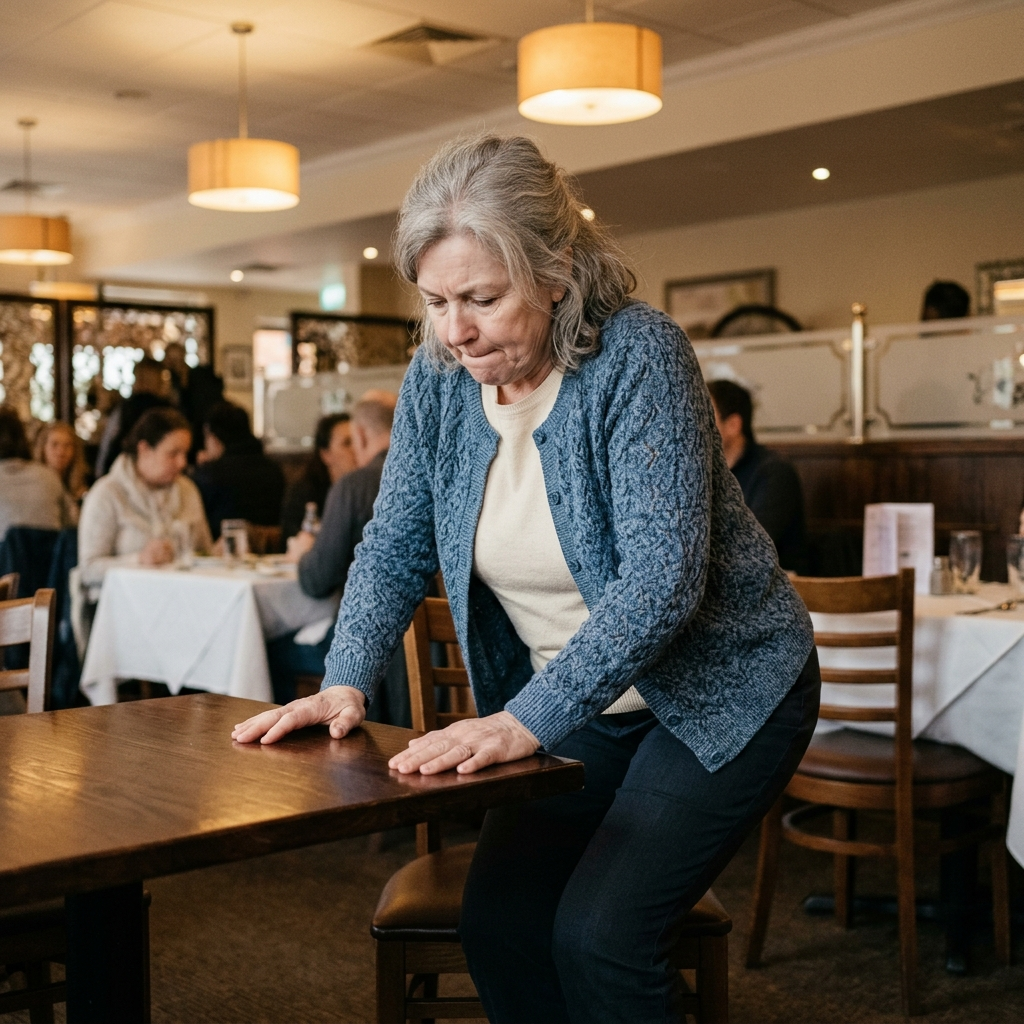
When the bill came, I planted both hands on the table edge and pushed. My knees did not unlock. My hips felt welded to the seat. I rocked forward twice before I could get my weight over my feet, and the couple in the next booth stopped eating to watch.
I laughed and said my legs had fallen asleep.
That became my life. Choosing chairs by whether they had armrests. Avoiding my daughter's low sectional. Standing in my own kitchen after dinner because getting up from the table took a performance I did not want my grandchildren to see.
Mornings were worse. Ten seconds after the alarm, my knees were concrete. By the time I reached the bathroom, I was gripping the hallway wall like a woman twice my age.
Three or more of these describe your day?
- Joints that stiffen and lock after sitting for more than ten or fifteen minutes
- A slow, two-handed push off every low seat, booth, or car while people watch
- Mornings that take thirty minutes to an hour before your knees and hips will bend properly
- Avoiding the floor, low couches, and any seat you cannot push yourself out of
- Knees that grind, pop, or catch when you finally do stand — and sometimes buckle
- A scan that came back "mild" or "normal for your age" while your joints still feel like they belong to someone thirty years older
Three or more? Then this article is for you. The missing piece is the same no matter which joint does it.
Six Minutes With Dr. Mercer. "It's Just Aging." Ibuprofen. Then Nothing.
I brought a list because I was afraid I would leave something out. Knees lock after sitting. Hips seize in the car. Morning stiffness lasts forty minutes. Cannot get off the floor. Ibuprofen three times a day and my stomach burns.
Doctor Mercer pressed along my kneecaps, asked me to straighten my right leg, and said the sentence I would hear for the next nine months.
"You are sixty-three. This is what happens. Keep moving. Take ibuprofen if you need it."
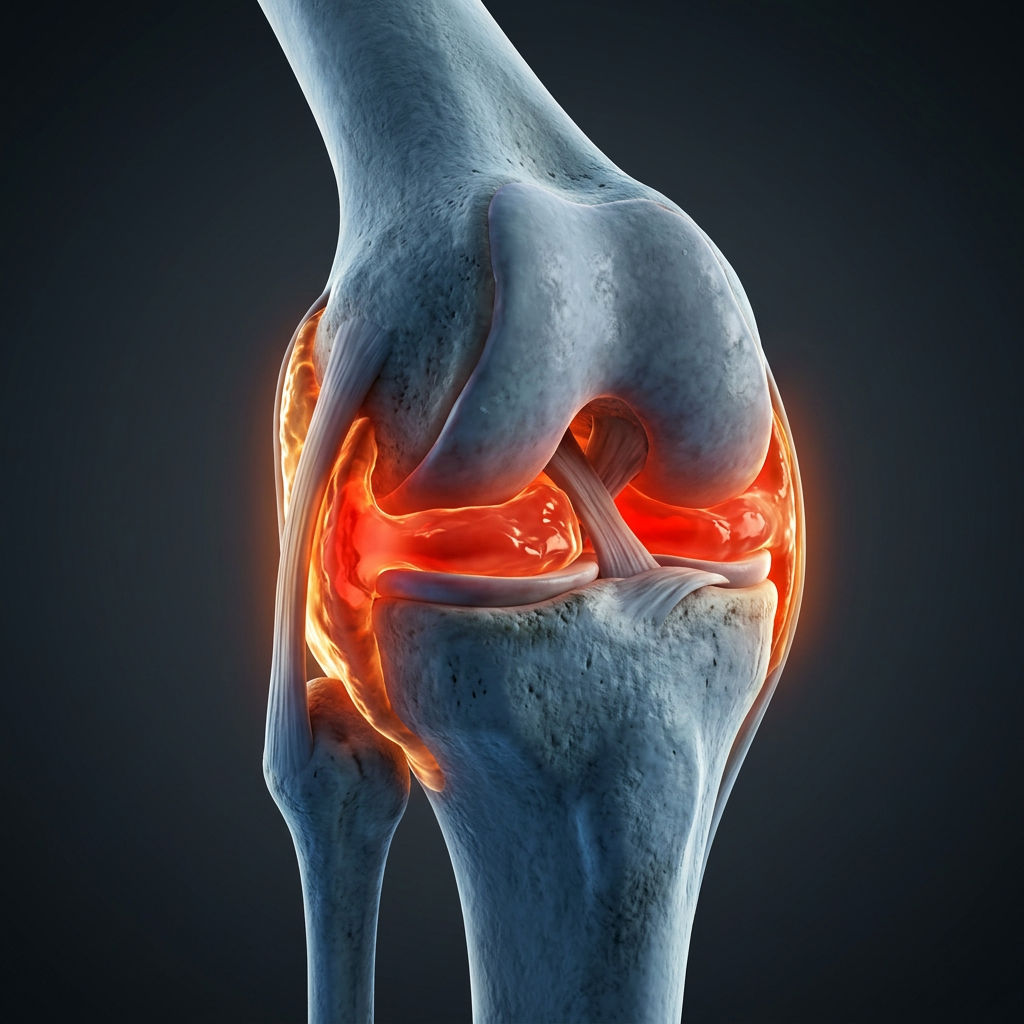
She did not say inflammatory gelling. She did not say that a joint can lock after stillness because inflammation pools in the capsule while you sit, and the longer you stay still, the worse the seizure when you try to stand.
She treated it like an age stamp that came with the birthday card.
Six minutes in an exam room. Nine months gripping armrests and hallway walls.
Eleven Things I Tried Before PEA — And What They Cost Me
I am going to lay this out plainly, because I want you to see the trap I was in. Maybe you are in the same one right now.
Eleven things. Nine months. Roughly $710 out of pocket, plus the mornings I lost and the chairs I stopped trusting.
The worst part was not that each thing failed.
The worst part was that every failure trained me to expect less from my own body.
The forums were full of people like me.
"We sat for a few and I could NOT get up. I looked like I was 87 yrs old."
"I would come home and sit in my car, in extreme pain for up to 2 hours, before I could get out."
"My leg buckled on me today and I fell. There's no way that's mild osteoarthritis."
"I have my life back. I feel decades younger."
I was not describing a chair problem. I was describing a joint problem nobody in my normal life could name.
My Granddaughter's Floor And The Two Hands I Needed Just To Get Back Up
The afternoon it broke me was a Sunday at my daughter's house.
Sophie had the wooden blocks out. She pulled my hand and said, "Grandma, come build." She is four. She does not ask twice.
I lowered myself to the carpet using the coffee table edge. My knees popped loud enough for my daughter to look up from the kitchen.
We built a tower. Sophie knocked it over. We built a second one. Fifteen minutes on the floor. The happiest fifteen minutes I had in months.
Then I tried to get up.
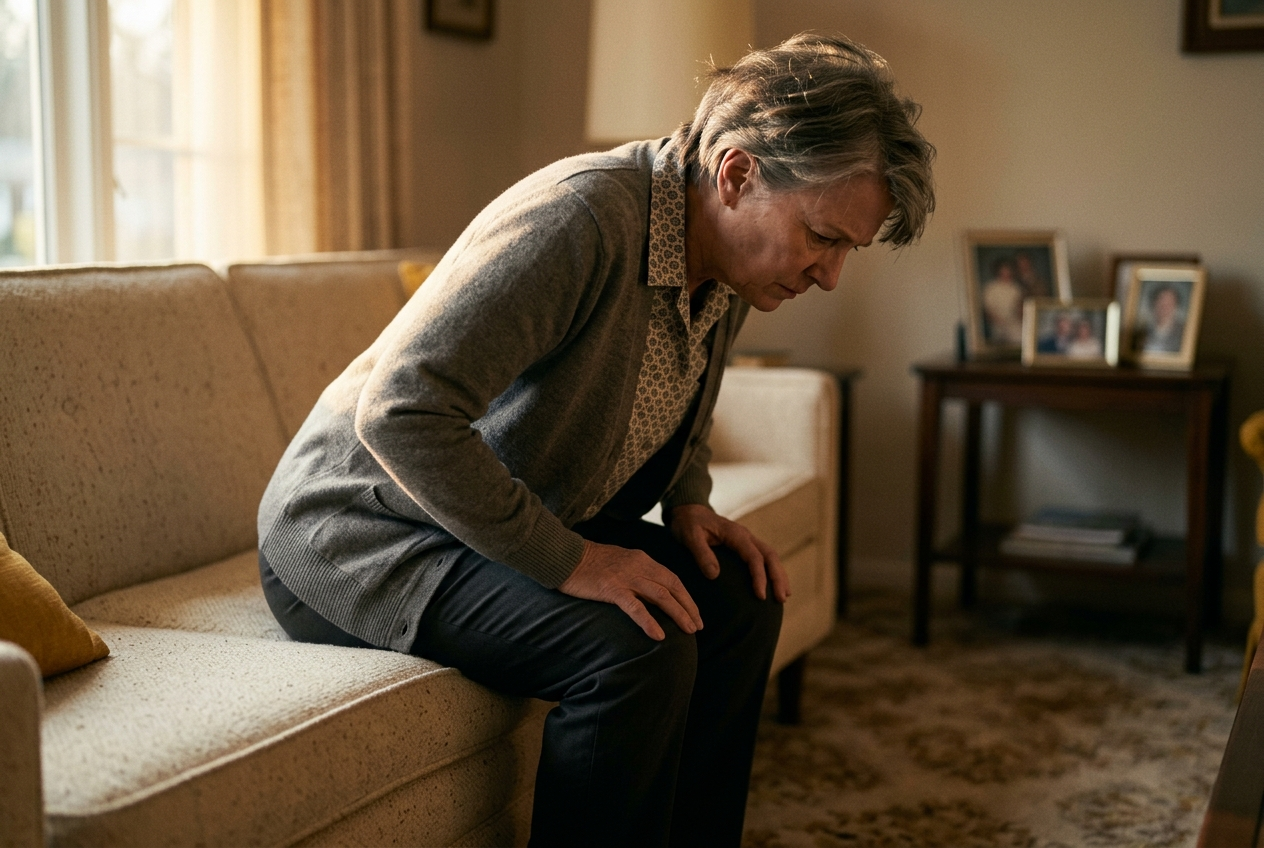
My knees would not straighten. My right hip locked at forty-five degrees. I grabbed the coffee table. It slid. I grabbed the couch. I pulled myself up one arm at a time while Sophie watched me and my daughter said, "Mom, do you need help?"
I said I was fine and walked to the kitchen counter to lean on something solid.
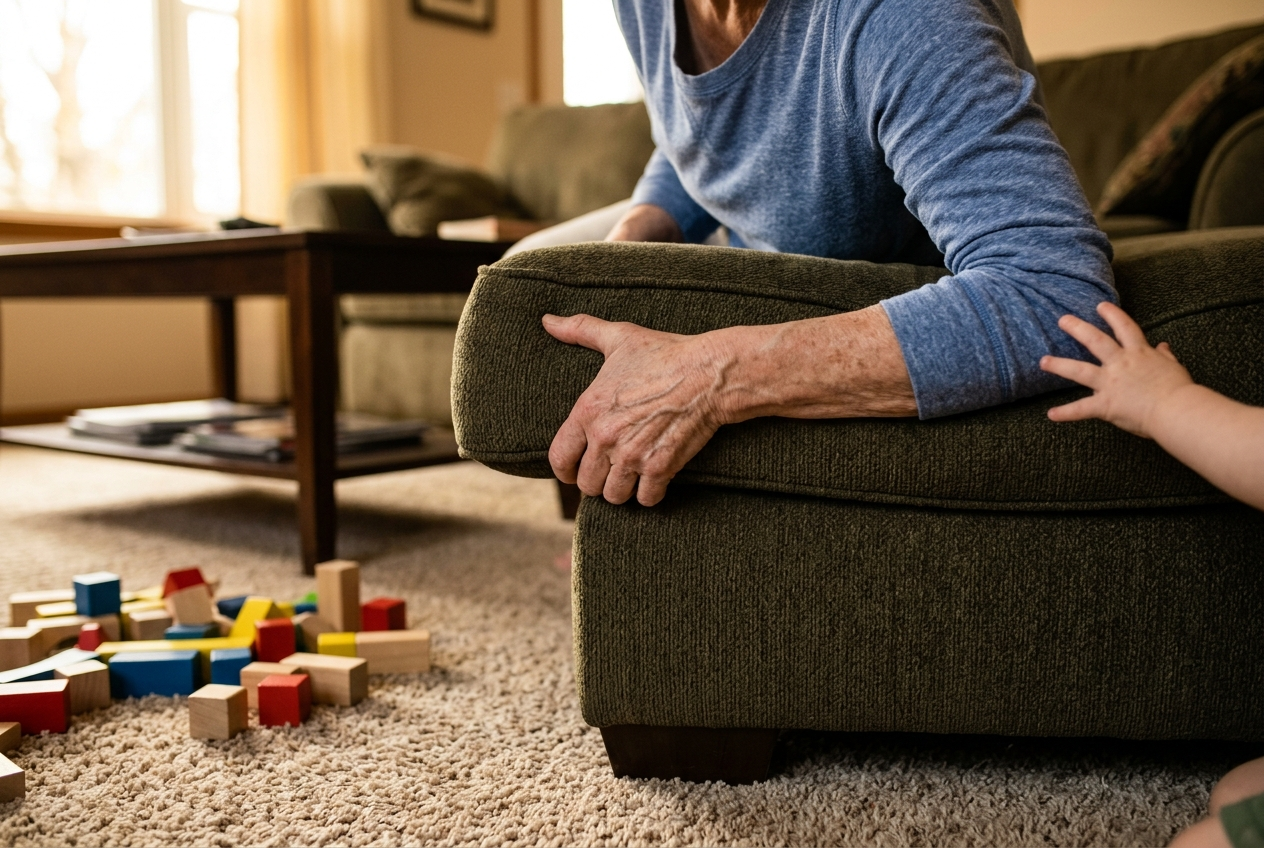
I remember thinking, this is how my world gets smaller.
First the floor. Then low seats. Then stairs. Then I stop saying yes to anything that puts me below standing height because getting back up is a gamble.
At sixty-three, this is also how women I know end up in a facility. Not from one big event. From a thousand small accommodations — a fall reaching for the couch, a broken hip, a hospital, a son calling about assisted living.
I was not going there. Not over a chair I could not get out of.
The Search That Named The Inflammation
Two nights later I searched the phrase I was embarrassed to type: "I can't get up from chairs arthritis and I feel like I'm 87."
Pages of people. The same shape of stiffness across different joints, different scans, different doctors. The same idea everywhere: the cartilage could be intact, the X-ray could look "mild," the doctor could say "normal for your age," and the joint could still lock after every time you sat still.
The chair and the joint are not the same thing. A chair holds you still. Stillness lets the inflammation pool. Calming the inflammation is what lets you get back out of the chair.
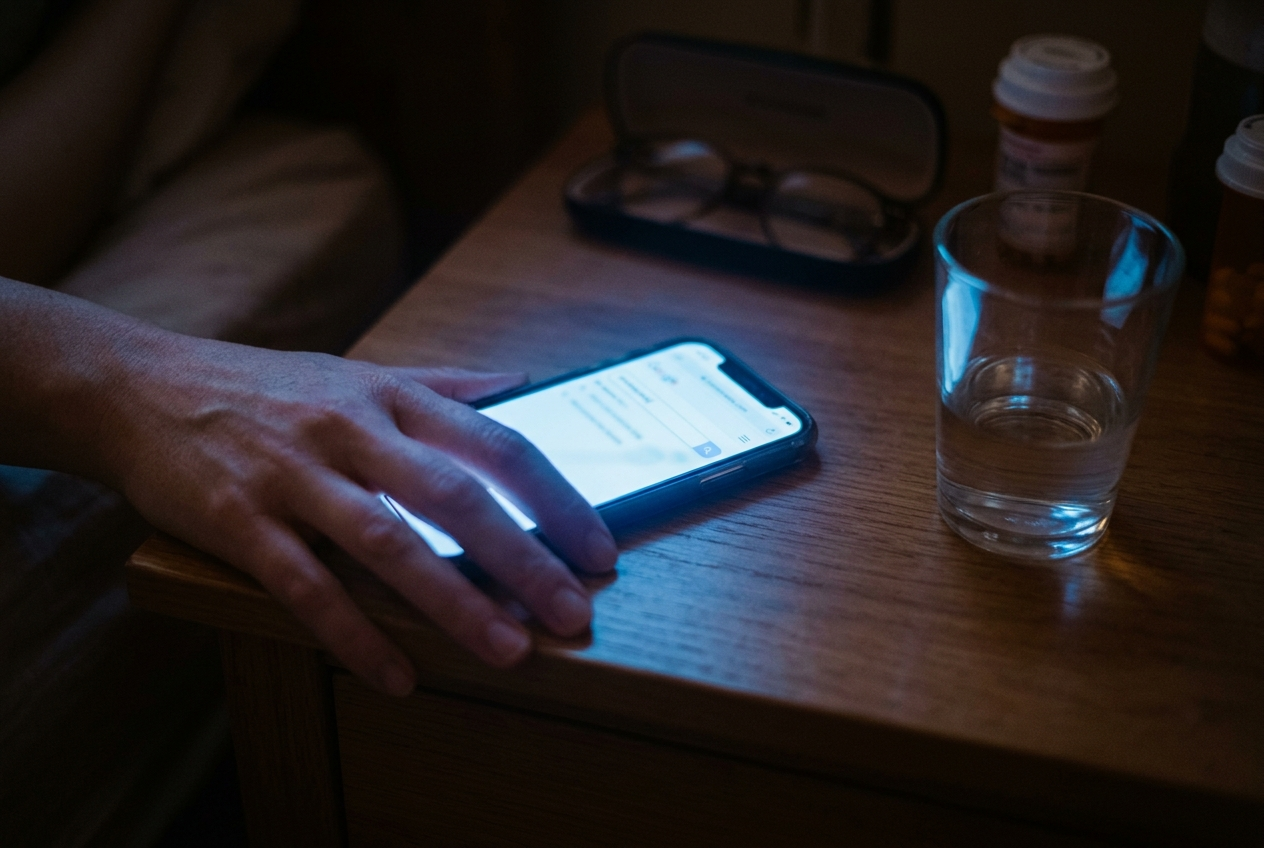
Different joints. Same lock. One calming compound the body already makes — and makes less of after 50.
That is where I found PEA.
Palmitoylethanolamide. I could not spell it the first week. Now I take it every morning.
Your body already makes it. The research kept pointing to the same idea — PEA helps quiet the inflammatory signaling that keeps joints stiff and locked after you sit still.
What The Research Actually Says
I am not a doctor. I am a school library aide who has read more clinical abstracts than I ever expected to. Here is what I found, with citations.
Sources: Lang-Illievich et al., 2023 Nutrients systematic review and meta-analysis; Schweiger et al., 2024 Nutrients extended micron-size meta-analysis; Steels et al., 2019 double-blind placebo-controlled knee osteoarthritis study; Gabrielsson, Mattsson & Fowler, 2016 Br J Clin Pharmacol safety review.
Why Nobody Named It In The Room Where I Was Paying To Be Helped
Your body makes PEA. No drug company can patent it.
No $400-a-month branded version for an insurance line item. No sales rep walking into Dr. Mercer's office with PEA samples and a free lunch. No marketing budget pointed at the six-minute appointment that was supposed to be my answer.
The system is built to see what it can photograph on an X-ray, prescribe, inject, brace, or bill.
Nobody told me the joint was locking because inflammation pools in the capsule when you sit still. That was the whole missing piece.
So I went looking for the right bottle myself. The form mattered. The dose mattered.
In ordinary form, PEA is hard for the body to absorb. The one I chose was micronized — particles milled small enough that the body has a real chance of using them. Most cheap PEA on the shelf is not micronized. The label will not always tell you.
And it was 600mg, the number tied to the clinical research and the product protocol.
Less than that, or the wrong form, and I would end up with one more bottle that looked right on the label and did nothing where it counted.
Stock check, this morning. This batch opened at over 5,200 bottles. As of the time I am writing this, 876 are left in the July run. Bottles have been moving faster than the mill is replacing them.
Week 2: I Got Up From The Kitchen Chair Without Grabbing The Table
I found the one that matched every line of what I had read.
Micronized. 600mg. Made in the USA. Third-party tested. Sold direct.
It is called Youfirst PEA 600MG.

My label check was simple: micronized, because absorption was the category trap. 600mg, because that was the number tied to the published research. Third-party tested, with the seal on the bottle. Made in the USA in a GMP-certified facility. No proprietary blends — what is on the label is what is in the capsule. 90-day money-back guarantee — not thirty, not seven business days.
No miracle promise.
Just the right form, the right dose, and a reason to believe this was not another random bottle from a shelf.
I ordered one bottle and told nobody. Not my daughter. Not my sister. Not even my husband.
If it failed, I did not want an audience.
Nothing dramatic happened.
That mattered.
No wave of relief. No movie-scene moment. No sudden cure.
I almost decided it was another glucosamine.
Then I remembered what I had read. Inflamed joints do not calm on command.
I stood up from my kitchen chair after dinner without grabbing the table.
I did not notice it until I was already at the sink.
Usually, I would plant both hands on the table edge, push, wait for the knees to unlock, then straighten one hip at a time before I trusted my legs to walk.
That night I looked down at my hands rinsing a plate and realized I had not braced on anything.
The stiffness was not gone. But it was softer.
Soft enough that standing did not own me.
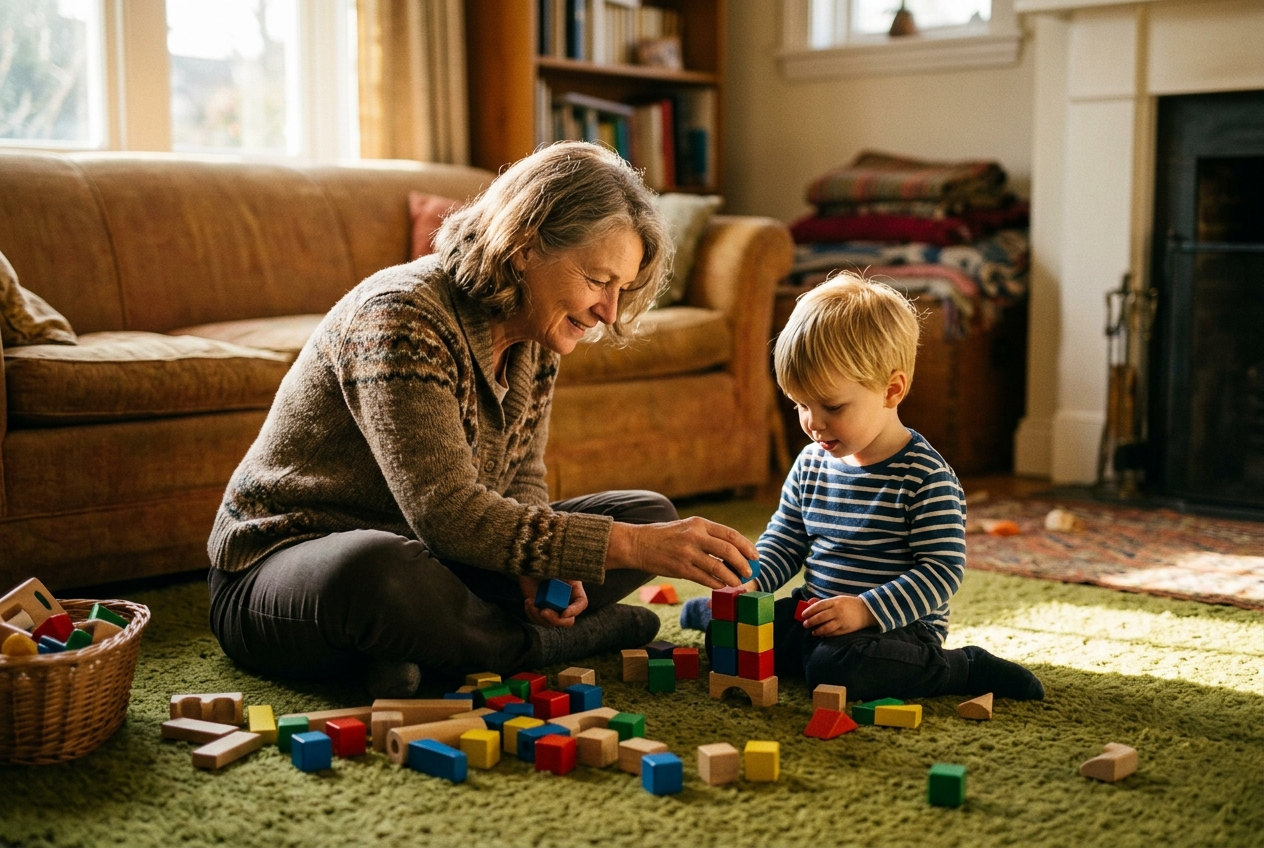
By week four, I got down on the floor with Sophie.
Not perfectly.
I used the coffee table to lower myself. My right knee popped once. I stayed down for twenty minutes building a garage out of Magna-Tiles.
Then I stood up.
One hand on the couch arm. One push. Up.
My daughter was in the doorway.
She did not say anything. She just watched, and I saw her eyes water.
That was the whole review.
Then I ran out.
Four days waiting for the next bottle.
By the third morning without it, the old stiffness was back. Forty minutes to unlock. The hallway wall grip. Not as bad as before. Enough to make me set up the subscription that night.
The moment I knew was not dramatic.
I got up from my sister's low couch during a family lunch and walked to the kitchen without calculating a single thing.
I stood up like a person who expected her knees to work, which I had not done in nine months.
It has been three months. Most mornings the joints unlock in minutes now, not an hour. A cold day still stiffens, but stiff is not seized, and the chair is no longer a calculation.
My granddaughter does not know there was a time I could not get off her floor. My daughter has stopped hovering when I sit down. To them, this is just what Grandma is like. That is the real measurement.
The Three Letters Of Reader Mail That Made Me Decide To Write This
After my daughter shared my story to her women's Bible study, the emails started. Three of them sit in my inbox. They are the reason I wrote this article instead of letting it stay private.
From Ruth S., 68, Tulsa, Oklahoma. "I sat in my car in the Walmart parking lot for forty-five minutes last March because I could not push myself out of the driver's seat. My hip had locked. A stranger finally asked if I needed help. By week five on this bottle I drove to my granddaughter's piano recital and got out of the car like it was nothing. First time in a year I arrived somewhere without dreading the parking lot."
From Gloria P., 65, Stockton, California. "I moved my bedroom to the first floor in 2024 because the stairs were taking me five minutes each way, gripping the railing with both hands. My husband carried the mattress down. I cried. Eight weeks on this bottle I walked upstairs to get a sweater and did not realize what I had done until I was back in the kitchen. I sleep upstairs again."
From Don A., 71, Greenville, South Carolina. "Three cortisone shots, a year of PT, and a surgeon who kept saying replacement was the next step. I could not get out of a church pew without the usher watching. Easter Sunday on this bottle I sat through the whole service and stood for the hymns. My wife leaned over and whispered, 'You just stood up.' I had not even thought about it."
Three different joints. Three doctors who never named the inflammation underneath. One compound the body already makes.
The Offer I Found When I Went to Reorder — and Why It's Only This Batch
Every one of those letters had a second person in it. Ruth has a husband with the same knees. Gloria has a sister who stopped visiting because the front porch steps are too much. Don's wife is the one who emailed me — not Don. Three letters, six people. Three locked in a chair, three watching.
That is the part that would not leave me alone. For every person who finds this, there is someone at their own table who has not — and an article does not reach that second person. A bottle already in the house does.
When I went back to reorder, I found they were marking 4th of July with something that matched exactly what those letters showed me. Not a discount gimmick. Something you could hand to the person beside you.
For this batch, order two bottles and the third comes free. The free one is not for you. It is the one you give away.
Not a coupon. Not credit toward a future order. A real, physical third bottle of the same micronized 600mg, in the same box — for the husband whose knees lock in the car, the sister who stopped taking stairs, the neighbor who finally asks what changed.
Two to give the joint the weeks it needs. One to pass across the table.
It is tied to this batch, and this batch is moving. 876 bottles are left as I write this. When they are gone the offer goes with them — the next run is six to eight weeks of milling and testing behind it, and there is no overnight reorder on something milled this fine.
Your two bottles get your own chair back. The free one gets it back for the person you would hand it to.
That is the only thing I would add to everything I have already told you.
What another year of this actually costs you.
- Getting up: another year of the two-handed push off every chair, every pew, every car seat while someone watches and looks away
- Stairs: another year of gripping the railing with both hands and choosing rooms by what floor they are on
- Money: another round of glucosamine, braces, copays, cortisone shots, and appointments that call it aging
- Family: another year of saying no to the floor, no to the park bench, no to the low seat at your granddaughter's table
- Strength: a joint you keep protecting is a leg that keeps weakening. A weaker leg at sixty-three is not the same as a weaker leg at forty-three
- Falls: the part nobody wants to say out loud. Locked joints change how you stand. How you stand changes how you balance. How you balance changes what happens on a bad morning
- Independence: the chain of small accommodations is how women I know ended up in a place they did not choose. Not from one event. From a year of small ones
- The joint: an inflamed joint does not become calm just because you got better at avoiding low seats
I am sixty-three.
The line that stayed with me from the forums was, "I have my life back. I feel decades younger."
I hated how much that sounded like what I wanted to say.
I am not in the habit of recommending things to strangers.
But if your mornings look like mine did, I am going to tell you what I would tell my own sister.
I tried things that aimed at the chair, the brace, the cream, the surface, and the waiting game.
The only thing that made the weeks start moving the right way was supporting the inflammation-calming signal my body should have had enough of in the first place.
I will be straight with you because I wish someone had been straight with me.
There was one more study I only found after I had already started. A double-blind placebo-controlled trial on knee osteoarthritis at this exact compound — PEA — found it reduced knee-OA pain and associated symptoms versus placebo. Sleep was the first thing that came back for me too. The mornings eased before the chair did, and the chair eased before the floor.
It did not erase the stiffness in the first week.
Mornings shortened first. Then the chair unlocked faster. Then the stairs stopped being a negotiation.
By week two, I could stand up without bracing.
By week four, I could get off the floor.
By week twelve, I had to think for a second to remember which knee had been the worst.
They took nine months of my life.
Do not hand them another year.
What Joint Pain Really Costs In America (And Why The Math Stops You Cold)
Before you scroll past the price, let me show you what the medical system would charge to "manage" this for the next three years. I checked the bills. I have the receipts. The math is obscene.
Over three years, the medical system can bill you north of $50,000 to manage a problem the body was built to calm itself.
No more — the part you stop noticing first.
No more two-handed push off every chair while you pretend nothing happened.
No more avoiding your granddaughter's floor because you cannot get back up.
No more mornings that take forty minutes before your knees will bend.
No more calculating which seats have armrests before you walk into a room.
No more ibuprofen on an empty stomach three times a day and a gut that is paying the price.
No more stairs you plan your day around, rooms you avoid, and visits you cut short.
Money-Back
Guarantee
This is the one I take every morning now. Go see if it is still in stock where you are.
Get the bottle Diane takes →They give you 90 days. If it does nothing, you send it back and they refund you.
In eighteen months and 47,000 bottles shipped, the refund rate sits at 0.4 percent — roughly four people per thousand. Two of them could not swallow capsules (the team told me they should have asked). One returned an unopened bottle because his daughter had already gifted him one. The rest were honest non-responders, refunded within 48 hours, no forms, no friction.
The Bottle Stayed Beside The Coffee Maker
After I set up the subscription, the bottle stopped feeling like a test.
It became something I checked off in the morning before I opened the curtains.
That mattered to me more than a dramatic promise.
A bottle I could keep taking was easier to believe than a miracle I did not trust.


P.S.
Last week my granddaughter asked me to sit on the floor again.
I did not grab anything on the way down. And I stood up with one hand on the couch, without thinking about it.
She handed me the green Magna-Tile because she wanted me to build the roof.
That is the part I will never get to explain to the doctor who told me this was just aging.
PPS. If you are the "just keep moving" reader — the one whose doctor handed you a stretching sheet and told you ibuprofen and walking would manage it forever — this is the message I would have wanted at month four. The inflammation does not stop pooling because you took a walk. It needs the calming signal your body should have had enough of in the first place. Ruth from Oklahoma sat in a Walmart parking lot for forty-five minutes. Read her letter again if you missed it.
PPPS. If you are the "mild on paper" reader — the one whose X-ray came back "normal for your age" while your knees buckle in the kitchen — the scan grades the cartilage. It cannot photograph the inflammation packed around the joint. That inflammation is what locks you up after you sit, and it is what PEA was made to calm. Gloria from California moved her bedroom downstairs. She sleeps upstairs again.
Comments
6 commentsGot up from the couch after the evening news last night. No grip on the armrest. No rocking forward. Just stood up. First time in eleven months. Ordered the second bottle before I went to bed.
Doctor told me it's just wear and tear. I'm 69. Four weeks on this and my wife said I walked up the porch steps without holding the rail. I didn't believe her until she showed me the Ring camera.
Bought two bottles for my dad for Father's Day. He called me on week three and said he got off the floor after playing with the dog. He's 74. He cried. I cried. The dog had no idea what was happening.
Wichita. Two cortisone shots. Twelve weeks of PT. One gel injection that did nothing. Glucosamine for six months. Week three on this and I sat through my grandson's baseball game on those metal bleachers. First full game since last spring.
I returned the last three joint-support bottles I tried. I kept this one. That should tell you enough.
Skeptical. Cheap. Stubborn. My wife ordered it for me. Now I take it every morning beside the coffee maker.