Why So Many Adults Over 50 With Arthritis Who Can't Take NSAIDs End Up With Nothing — and Why Tylenol Never Calms the Fire
 By Catherine Hale, Health Correspondent✓ Verified reporting
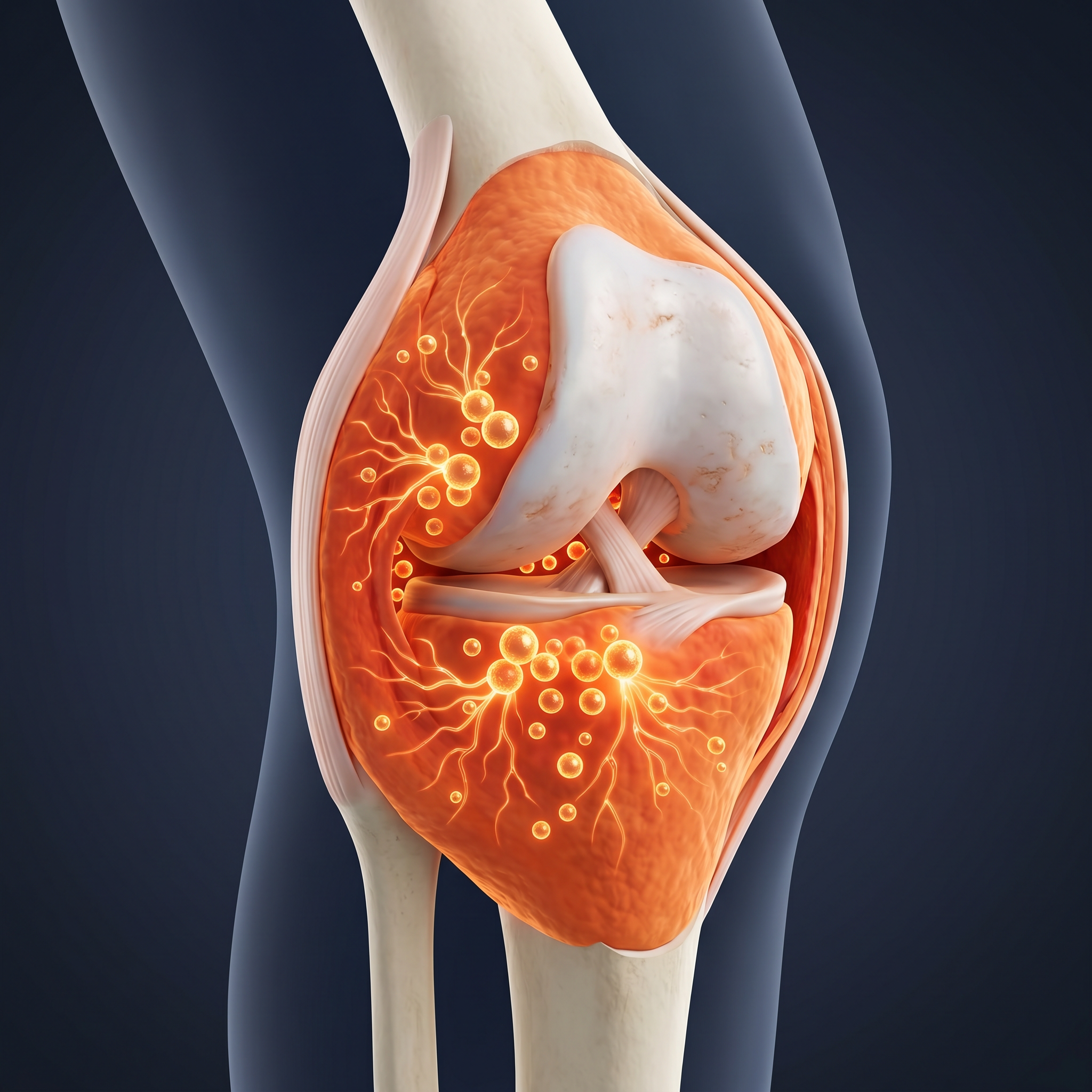
If your mornings start with a grip on the nightstand and Tylenol, topical cream, and a heating pad have each failed to reach whatever is keeping the joint locked, the problem may not be your effort or your age. It may be that every replacement is aimed at the wrong target.
7:40 a.m. The medicine cabinet with nothing in it
Something changes, and for a while you absorb it because there is nothing else to do. You wake up and your knees are locked. You grip the nightstand to stand. You open the medicine cabinet where the ibuprofen used to live and close it again, because the last bottle put you in the gastroenterologist's office.
Then it is the staircase you avoid. The grandchild on the floor you cannot get down to. The grocery run you split into two trips because your knees seize after twenty minutes of walking, and nobody sees the arithmetic that runs in your head before every errand.
Most people tell themselves the same thing: it is aging, everyone stiffens, it is normal. You adjust around it. You reach for the Tylenol.
But it is not just aging in the way you think. And Tylenol is not reaching what is actually lit.
Before the mechanism matters, the pattern matters. A problem that starts as a stiff morning often becomes a whole day planned around stairs, handholds, and which rooms have something to grip.
The Pattern Most People Blame on Getting Old

Before the inflammation pathway is explained, count the daily workarounds that may have quietly become normal.
Three or more? Then the missing piece may not be willpower. It may be a joint whose inflammation has stayed lit long after the cartilage wore, with no safe way to calm it left in the cabinet.
The visit that took the pill away. Then offered nothing in its place.
The visit usually goes the same way. The doctor pulls up the labs, reviews the stomach history, and lands on the sentence most people in this particular spot have already heard once:
"You can't take anti-inflammatories anymore. Not with your stomach. Try Tylenol and keep moving."
What rarely gets said in those seven minutes is the part that matters. A joint can keep grinding because the inflammation around it is still active, long after the cartilage first wore down.
Treated like normal aging with no safe daily option, it gets sent home to wait.
Seven minutes in a room. Months of a life rearranged around pain with no pill.
What Is Left When the Anti-Inflammatory Is Taken Away
Most people in this spot do not arrive here because they gave up. They arrive after the one thing that worked was taken off the table.
That is the trap: each attempt is reasonable. But if the joint is still inflamed from the inside out, and the one pathway that reached it is off limits, every option misses the fire.
What The Pattern Points To Inside The Joint
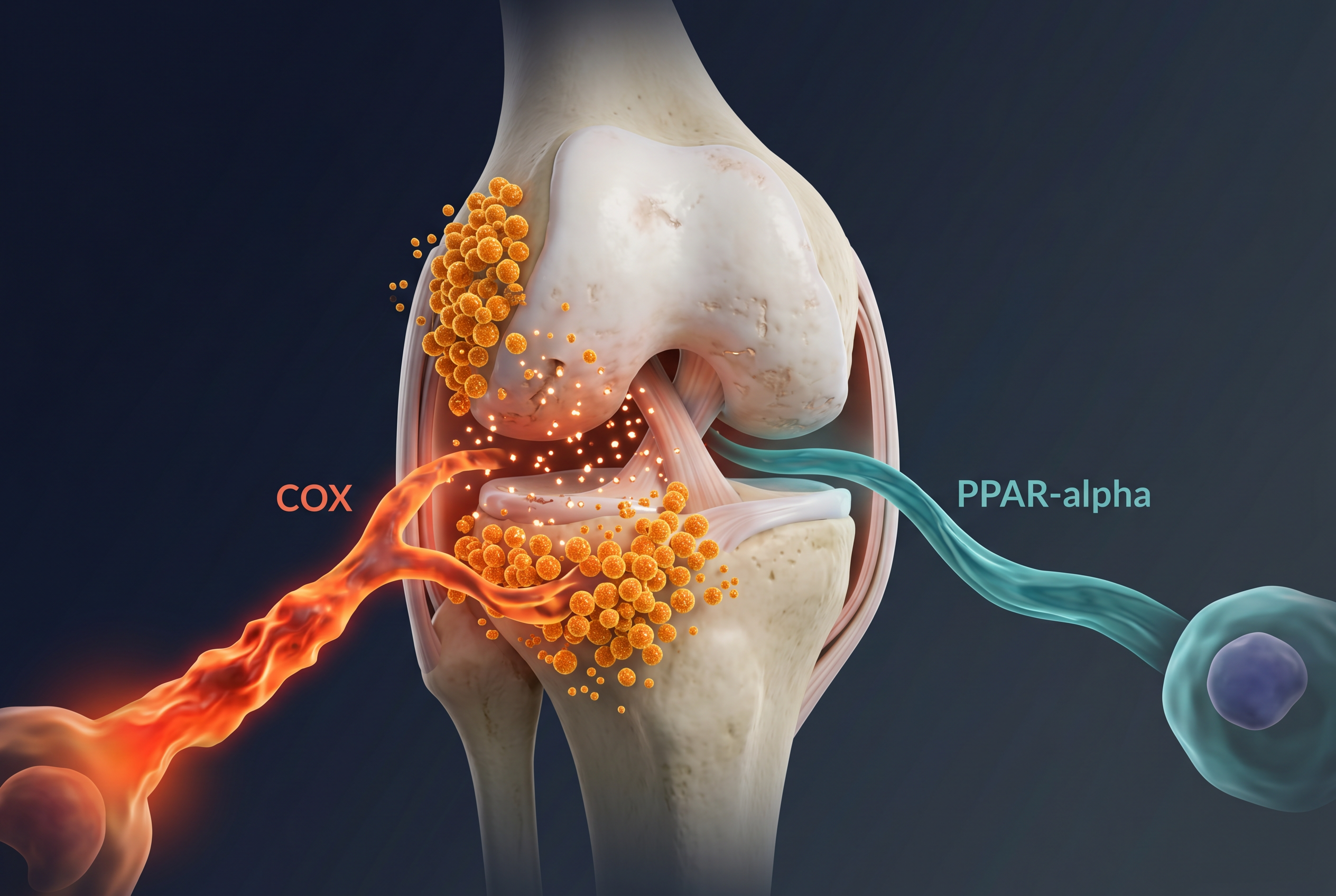
Once the pattern is visible, the usual explanation starts to look incomplete: it is just wear and tear.
Yes, cartilage wears. But researchers also describe a second layer: the tissue around the joint can become chemically inflamed and over-reactive, so ordinary movement lands on it like weight on a fresh bruise.
That inflammation is kept alive by over-active mast cells flooding the joint capsule with inflammatory signals. The body has a built-in off-switch for this. It runs through PPAR-alpha.
That is why a person can take Tylenol, apply the cream, and ice the knee every night, and still wake up with the same grinding lock the next morning.
Why Tylenol, Creams, And Cortisone Miss The Fire

The honest summary is short. The three options left after NSAIDs are gone (Tylenol, topical creams, cortisone shots) each act on something other than the mast-cell fire inside the joint.
Tylenol blocks pain signals in the brain. That can dull the sharpest edge for an hour, but it does not touch the inflammation keeping the joint locked.
Topical creams reach the skin. For many people they help for twenty minutes, but they are not built to penetrate the joint capsule where the fire lives.
Cortisone calms a flare. It can make a bad month bearable, but it fades within weeks, and chronic use can degrade the cartilage it is supposed to help.
The Compound Doctors in Italy Have Used for Twenty Years

PEA, palmitoylethanolamide, is not a new molecule and not a herb. Researchers describe it as a fatty compound the body makes on demand to calm inflammation. It has been studied since 1954.
The mast-cell calming mechanism was characterized in 1993 by the laboratory of Nobel laureate Rita Levi-Montalcini. In Italy, PEA has been used for pain and inflammation for more than twenty years.
Most Americans have never heard the name for a plain reason: a compound the body already makes cannot be patented, so few companies have the incentive to turn it into a household name.
The evidence, though, is published and searchable.
Steels et al., 2019. A double-blind, randomized, placebo-controlled trial found that PEA attenuated pain and associated symptoms in patients with knee osteoarthritis. Search "Steels PEA knee osteoarthritis 2019."
Lang-Illievich et al., 2023, Nutrients. A systematic review and meta-analysis of 11 double-blind randomized trials covering 774 chronic-pain patients found PEA beat control on pain intensity (p < 0.00001).
Pickering et al., 2022, Inflammopharmacology. A randomized trial using 600mg per day for 8 weeks reported reduced nerve pain alongside improved sleep.
That sleep detail matters for what you should expect from the first weeks, and we will return to it.
Before You Buy Any PEA: The Label Check Most Buyers Learn Too Late
There is a trap for people who do their homework: they buy a shelf "PEA" or "joint support," take it for a month, feel nothing, and decide the compound was hype.
Often, the label tells the story: 300mg of plain, non-micronized powder, sometimes hidden inside a crowded blend. The dose is lower than many clinical protocols, and the form may be harder to absorb.
The label check most buyers learn too late
The Form That Actually Deserves The Test
PEA is not judged fairly unless the dose and form are right. It is a fatty compound, and plain powder can be hard for the body to absorb. That is why serious formulas use micronized PEA, smaller particles designed to improve uptake.
The research window also matters. Many shelf products use 300 to 400mg, while the stronger clinical pattern centers around 600mg.
That is the fair test: right compound, right dose, right form, and enough time for a building effect rather than an overnight miracle.
See the dose and back label for yourself →
In a 2023 systematic review of 11 double-blind randomized controlled trials, PEA showed statistically significant pain reduction versus control. The takeaway was measured, not miraculous: gradual inflammation calming over weeks, not an instant knockout painkiller.
Reported Voices From People Who Lived This Pattern
Before the product is named, the pattern itself is worth hearing in plain language: the lost mornings, the stairs avoided, and the slow return of normal tasks.
"I have my life back. I feel decades younger."
public arthritis forum"No more Tylenol and Meloxicam around the clock. The morning is mine again, and no one had to tell me it was working because I could feel it in the stairs."
Reported customer feedback, knee osteoarthritisThe Product That Meets All Three Conditions
To actually work, a PEA needs three things at once
YouFirstLabs PEA 600mg (Micronized)

Free US shipping · 90-day money-back guarantee
The label check is simple. Micronized, because absorption is the category trap. 600mg, because that is the number tied to the published research.
Third-party tested with the seal on the bottle. Made in the USA in a GMP facility, with no proprietary blends, so what is on the label is what is in the capsule. A 90-day money-back guarantee, not thirty, not seven business days.
What The First Month Actually Looks Like


Here is a realistic account of what changes, and when, told in the order people actually report it. It will not match an advertisement that promises tomorrow.
What People Are Saying
Reported customer feedback format:
“I reached for the ibuprofen bottle out of habit two months in, and then I realized I had not opened it in three weeks. My stomach has not felt this calm in years, and neither have my knees.”
Customer report · details withheld for privacy“Six weeks in. Got down on the floor with my grandson and his blocks yesterday. Got back up without grabbing the coffee table. My daughter watched me do it and started crying.”
Customer report · details withheld for privacyA Note on the Current Promotion
Why the extra bottle matters right now
For readers already planning a proper test, the current 4th of July promotion changes the math: order two bottles and a third ships free in the same box.
Buy 2 Get 1 FREE: a third physical bottle of the same micronized 600mg PEA, not store credit or a coupon.
The extra bottle is easy to pass on: a spouse, sibling, neighbor, or anyone else in the house whose knees grind every morning and whose stomach cannot take the usual pill.
The promotion is tied to the current batch, with 876 bottles still available to new buyers at the time of writing.
When this batch clears, the third-bottle offer reverts to single orders. The next tested run is not projected to clear for six to eight weeks, so the practical window is this batch, not an open-ended calendar sale.
The shelf comparison has already been covered above: dose, micronized form, clean label, and enough time for a fair test. From here, the more important question is how PEA fits beside the options people are already using.
What About Cortisone Shots, Gel Injections, And Knee replacement?
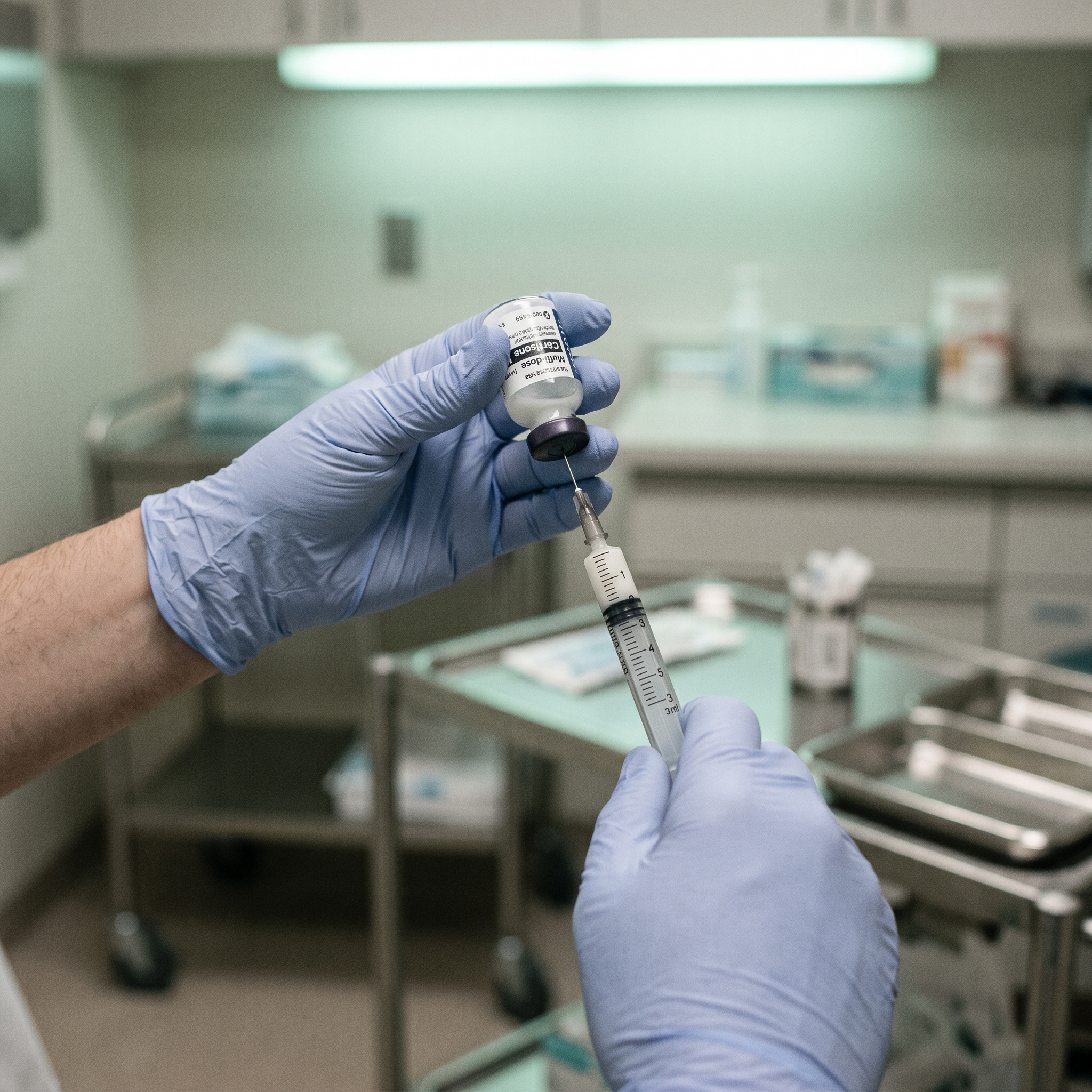

These are real options, and for some people they are the right call. A cortisone shot can break a terrible flare, gel injections help some knees for months, and total knee replacement has changed lives. The clinical data behind them is real, and nobody serious pretends otherwise.
The trade is what sends people looking. Cortisone fades within weeks and chronic use can degrade cartilage. Gel injections are a coin flip. Knee replacement is real and permanent, and many people are not ready, not cleared, or not willing to face the recovery alone.
PEA is not a replacement for any of that, and it is not a drug. It works on a different pathway, the inflamed joint itself, without the stomach or kidney cost, which is why many people take it alongside whatever their doctor has them on. Talk to that doctor before you change anything.
What the Other Roads Cost
It is worth putting the price of a bottle next to what the usual roads actually cost, in money and in time.
A single cortisone shot or specialist visit can run into the hundreds, and the relief commonly fades within two to three months before the next appointment.
Gel injections help some knees and, by their own accounts, "did nothing" for others. Knee replacement solves the joint permanently but costs tens of thousands, weeks of recovery, and a decision most people dread.
And underneath all of it sits a bathroom cabinet with nothing left in it but Tylenol and a topical cream that fades in twenty minutes, neither reaching the inflammation inside the joint. Against that, a bottle at the correct dose, behind a 90-day guarantee, is a small and bounded test.
Figures are representative 2024–2025 US costs. Cortisone injection series from BCBS and Medicare-advantage commercial claims; TKR range from HCUP NIS inpatient data; HA injection course from published payer analysis.
No more gripping the furniture to stand up while pretending you were just stretching.
No more mornings where the first thirty minutes are spent negotiating with your knees.
No more choosing rooms by which ones have something to hold onto.
No more grandchildren on the floor you cannot get down to because getting back up is the part you dread.
Two Directions from Here


| IF YOU CLOSE THIS PAGE ✗ Tomorrow: the same grinding morning with nothing safe to take ✗ Next week: the stairs you keep avoiding ✗ Next month: "is this just my life now, with no daily option" ✗ The cabinet still empty, the joints still locked | IF YOU TRY IT ✓ This week: the night throbbing starts to ease ✓ Next month: the morning loosens earlier and the stairs stop being a decision ✓ Over the research window: function builds back without the stomach cost ✓ You find out who you are when the inflammation is calm |
Money-Back
Guarantee
Free US shipping · 90-day money-back guarantee · While current batch lasts
They give you 90 days. If it does nothing, you send it back and they refund you.
What it looks like from the people taking it


A few closing notes
Whether your knees grind on the stairs or lock up every morning, whether the scan said mild or severe, the missing piece is the same. A joint does not stop being inflamed because the doctor took the anti-inflammatory away. It needs the calming pathway your body already has, through a door the stomach never pays for.
And the practical part. The form to look for is micronized, and the dose is 600mg. Sold direct at the official YouFirst site, not Amazon, so check the form and the dose before you buy it anywhere else.
DISCLAIMER
This article is for general information and is not medical advice. Palmitoylethanolamide (PEA) is a dietary supplement and is not intended to diagnose, treat, cure, or prevent any disease. Results vary between individuals, and benefit in the research built over weeks rather than immediately. Talk to your doctor before starting any supplement, especially if you are pregnant, nursing, or taking medication. Persistent or severe joint pain, sudden swelling, or loss of joint function needs prompt medical assessment.
REFERENCES & SOURCES
Steels et al., 2019, double-blind placebo-controlled knee osteoarthritis RCT: PubMed citation
Lang-Illievich et al., 2023, Nutrients, PEA chronic-pain systematic review and meta-analysis: mdpi.com/2072-6643/15/6/1350
Pickering et al., 2022, Inflammopharmacology, diabetic peripheral neuropathic pain RCT (600mg/day): link.springer.com/article/10.1007/s10787-022-01033-8
Schweiger et al., 2024, extended micronized-PEA meta-analysis: pmc.ncbi.nlm.nih.gov/articles/PMC11174044/
Mechanism background (PPAR-alpha, mast-cell / ALIA, Levi-Montalcini 1993): Petrosino & Di Marzo, 2016; Skaper, 2013.
Safety / tolerability across pooled trials: Gabrielsson, Mattsson & Fowler, Br J Clin Pharmacol, 2016.
Customer voice quotations are drawn verbatim from public discussion forums (osteoarthritis communities) and public retail reviews.