Why the Turmeric Capsules You Bought for Your Joints Were Never Going to Reach Them — and What the Label Hides in Plain Sight
 By Claire Ashford, Health Correspondent✓ Verified reporting
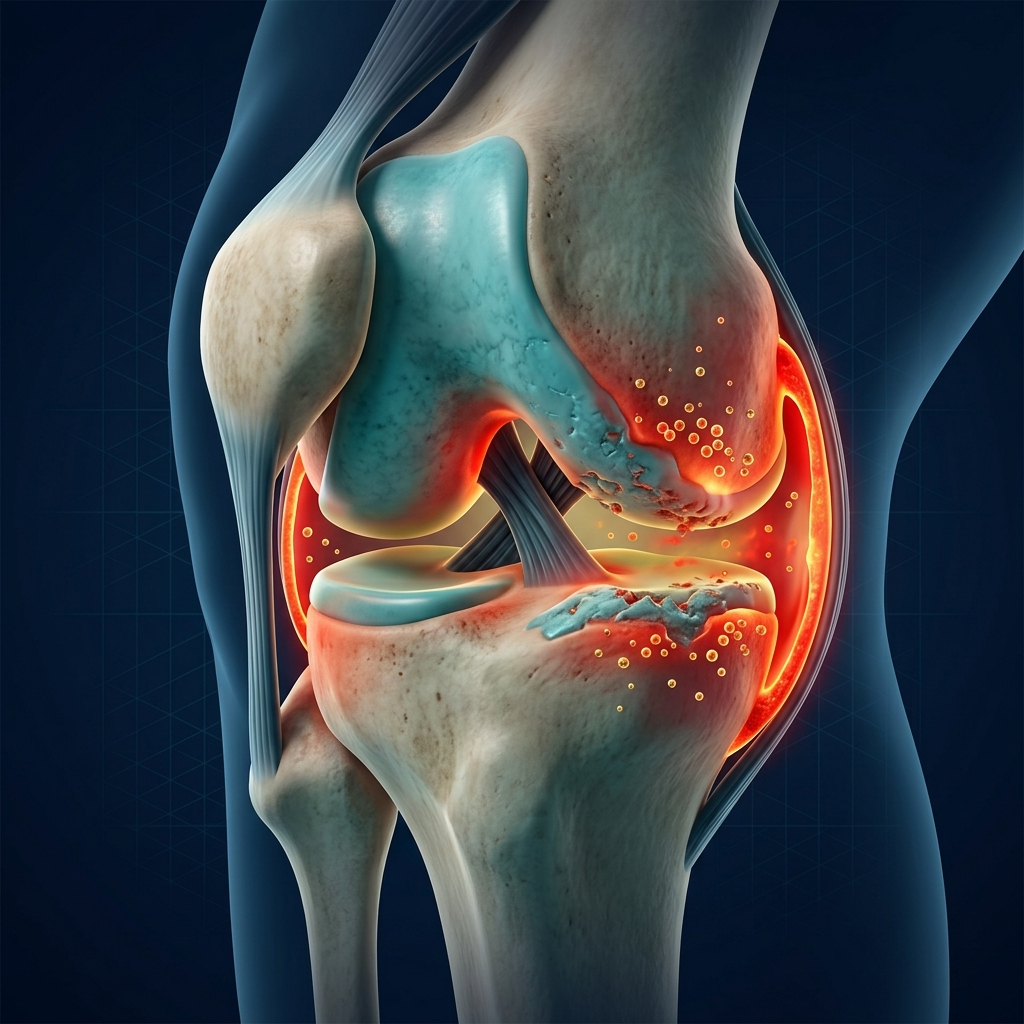
If your mornings now start with thirty minutes of grinding before the joints agree to move, and the glucosamine, the fish oil, the joint cream, and every other bottle in the cabinet have not changed a thing — the problem may not be your age. It may be that those bottles were aimed at the wrong part of the problem.
6:47 a.m. The first thirty minutes
Something stiffens, and for a while you explain it away. You swing your legs off the bed in the morning and both knees feel like they have been set in concrete overnight. You stand, and for the first thirty minutes the hips grind, the lower back locks, and every step feels ten years older than you are. By the time you reach the kitchen you are gripping the counter just to straighten up.
Then it is the staircase you start avoiding. The restaurant where you cannot stand from the low chair without the table edge. The grandchild who wants you on the floor, and the quiet calculation of whether you can get back up.
Most people tell themselves the same thing: everyone stiffens after fifty, it is just arthritis, it will loosen up if you keep moving. You take the ibuprofen and push through.
But the grinding rarely loosens on its own. And the ibuprofen is borrowing from your stomach every day.
Before the mechanism matters, the pattern matters. A morning that starts stiff often becomes a whole day planned around which rooms have a railing and which chairs you can stand from without help.
The Pattern Most People Quietly Write Off as Aging

Before the inflammation is explained, count the daily adjustments that may have quietly become normal.
Three or more? Then the missing piece is probably not effort. It may be that the inflammation locking those joints has outlasted every bottle in the cabinet, because none of them were built to reach it.
The advice sounds reasonable. Then the cabinet fills up.
The visit usually goes the same way. The doctor looks at the X-ray, presses along the knee or hip, and lands on the sentence most people in this spot hear:
“It is just arthritis. Everyone gets it eventually. Stay active, manage the weight, and take an anti-inflammatory when you need it.”
What rarely gets said in those seven minutes is the part that matters. The ibuprofen she takes every morning works on a broad pathway that bills her stomach and kidneys for every dose, and the joint inflammation it briefly blunts comes back the moment it wears off.
So she does what millions do next. She searches for something natural that does not cost her stomach. The internet, a friend, a health-food aisle. They all point the same direction.
Seven minutes in a room. Months of turmeric capsules that never arrived.
Why the Turmeric Could Not Have Worked from That Bottle
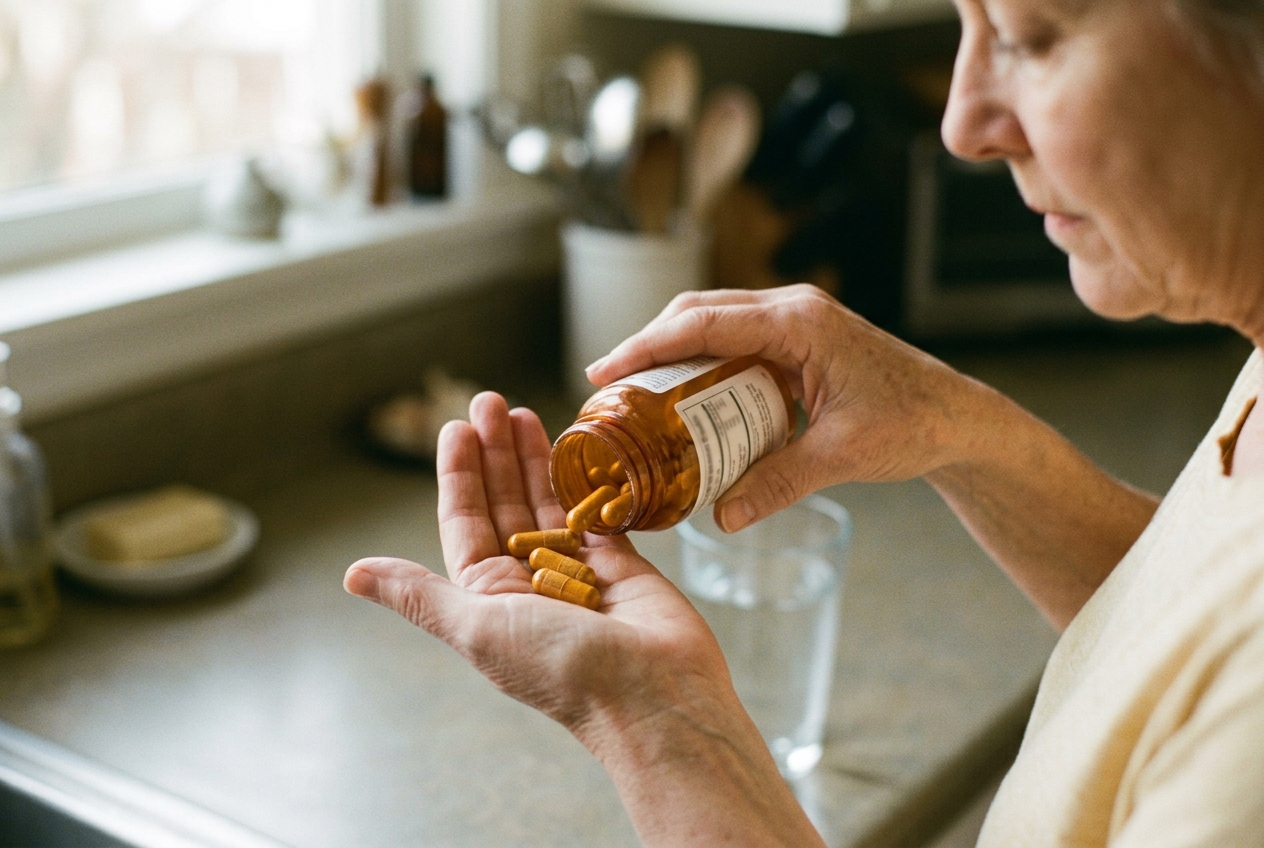
Once the pattern is visible, the explanation most people carry starts to look incomplete: turmeric.
Yes, turmeric contains curcumin, and curcumin has anti-inflammatory properties in a laboratory. But researchers describe a problem no supplement label mentions: the compound in a standard capsule is almost entirely destroyed or excreted before it can reach the joint, and no published human study has ever measured curcumin in synovial fluid after oral dosing.
That gap between what the label promises and what the body receives is kept open by three facts the supplement aisle has no incentive to explain.
That is why a person can take turmeric every morning for months, buy the highest-rated brand, and still grind when she stands from a chair.
What People Try First for Their Joints, and What It Costs
Most people do not arrive here because they gave up. They arrive after running the whole sequence the system hands them first.
That is the trap: each attempt is reasonable. But if the inflammation inside the joint has outlasted every bottle and every injection, surface fixes and short-window suppressors keep missing the actual target.
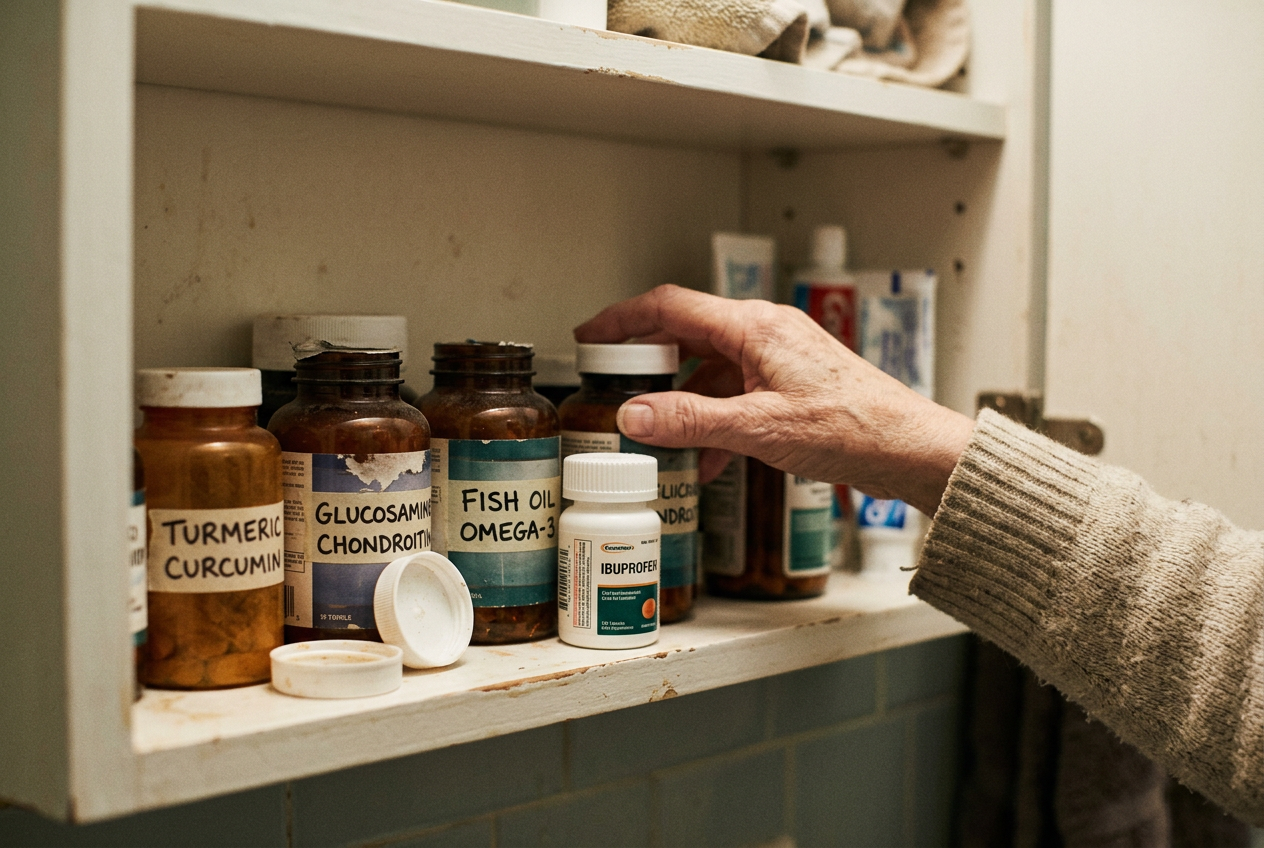
The honest summary is short. The thing she reached for when NSAIDs hurt her stomach was structurally incapable of finishing the job, and three facts explain why.
Turmeric powder is roughly three percent curcuminoids. The trials that reported modest joint benefit used a ninety-five percent standardized extract at five hundred to two thousand milligrams per day. The capsule in her cabinet is largely root powder with trace active compound. A buyer who ran the arithmetic on one leading brand found roughly twenty-five milligrams of actual curcuminoids per capsule, inside a label that said two thousand two hundred and fifty.
Even the standardized extract barely absorbs. Oral curcumin has an estimated bioavailability of about one percent. Habitual supplement users tested in a 2023 university cohort had plasma curcuminoid levels roughly a thousand-fold below what researchers consider plausibly beneficial. Piperine, the common enhancer, was shown in independent crossover work to add no measurable benefit at real-world doses.
And the dose that might actually help is the dose her stomach will not tolerate. In a balanced sample of over a hundred buyer reviews, a third flagged liver-enzyme or kidney concerns. Thirteen percent reported stomach pain, diarrhea, or reflux at the recommended three-capsule dose. One reviewer wrote plainly: she was too afraid to find out what the dose would be to benefit her joints without inflaming her entire digestive tract.
The Body-Made Compound Already in Your Joints — and Running Low
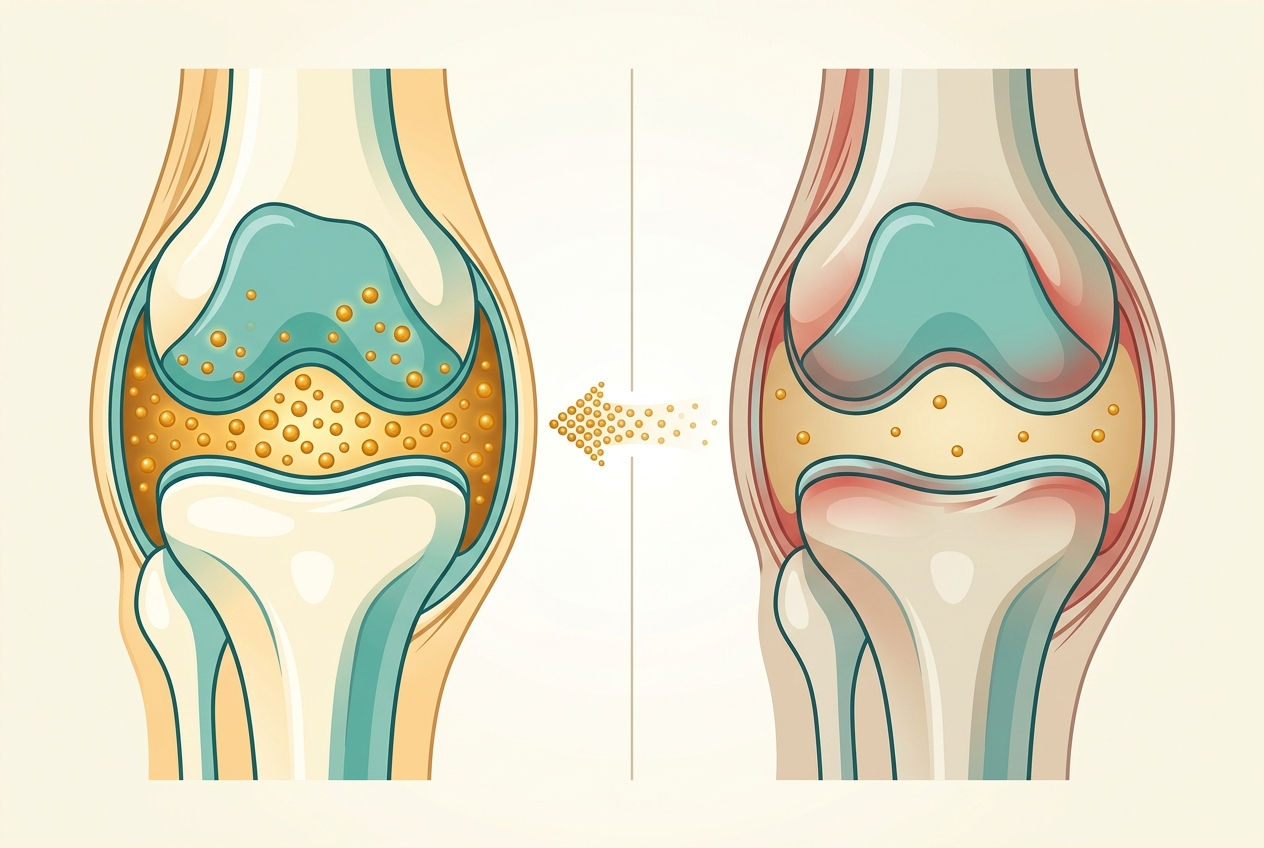
PEA, palmitoylethanolamide, is not a botanical and not a painkiller. Researchers describe it as a fatty compound the human body produces on demand at sites of injury and inflammation. It was first identified in 1957.
The mast-cell calming mechanism was characterized in 1993 by the laboratory of Nobel laureate Rita Levi-Montalcini. In Italy, PEA has been prescribed for joint and nerve pain for more than twenty years.
What makes it relevant here is a finding most turmeric buyers have never been told: in published research, PEA levels inside the arthritic joint are measurably lower than in healthy joints. The compound the body uses to resolve inflammation is depleted in the exact tissue where the inflammation will not quit. Supplementing it is not adding something foreign. It is restoring something the joint has run short on.
The evidence is published and searchable.
Steels, Vitetta et al., 2019, Inflammopharmacology. A double-blind, placebo-controlled trial of 111 knee-osteoarthritis patients. The 600mg group showed significant improvement in WOMAC pain (p < 0.001), stiffness, and physical function over eight weeks. Search “Steels PEA knee osteoarthritis 2019.”
Lang-Illievich et al., 2023, Nutrients. A systematic review and meta-analysis of 11 double-blind randomized trials covering 774 chronic-pain patients found PEA beat control on pain intensity (p < 0.00001).
Richardson et al., 2008, Arthritis Research & Therapy. LC-MS/MS analysis of synovial fluid: PEA levels were significantly lower in osteoarthritis and rheumatoid arthritis patients than in non-inflamed controls, with FAAH (the enzyme that breaks PEA down) active in diseased synovium.
In a 2019 double-blind trial, 111 knee-osteoarthritis patients took PEA or placebo for eight weeks. The 600mg group showed statistically significant improvement in pain, stiffness, and function. Separately, a 2023 meta-analysis of 11 double-blind trials found PEA beat control on pain across 774 chronic-pain patients. The results were measured, not miraculous: gradual reduction, not an overnight fix.
That last finding, the depleted compound in the arthritic joint, matters for what you should expect, and we will come back to it.
Cited research · publicly searchable
Steels, Vitetta et al., 2019, Inflammopharmacology. Double-blind, placebo-controlled trial in 111 knee-osteoarthritis patients. Micronized PEA at 600mg per day significantly reduced pain, stiffness, and functional limitation versus placebo. PubMed 30927159.
Lang-Illievich et al., 2023, Nutrients. Systematic review and meta-analysis of 11 double-blind randomized trials covering 774 chronic-pain patients. Statistically significant reduction in pain versus control.
Richardson et al., 2008, Arthritis Research & Therapy. PEA measurably present in the synovial fluid of osteoarthritis and rheumatoid patients — the direct evidence that the compound actually reaches the joint interior, in a way no oral curcumin study has ever demonstrated.
Before You Buy Any PEA: The Label Check Most Buyers Learn Too Late
There is a trap for people who do their homework: they buy a shelf “PEA” or “joint support,” take it for a month, feel nothing, and decide the compound was hype. Often, the label tells the whole story.
The label check most buyers learn too late
A direct word to the reader
If you have been on turmeric for three months, this is the state of your joints right now: you are ninety days into a bottle that could not reach the fluid your joints are running on. Ninety days of receipts. Ninety days of the same 6:47 morning. And nothing in the label was ever going to change that.
The article-reader window closes when Batch B0426 does. What you decide this week decides the next ninety mornings.
The Product That Meets All Three Conditions
To actually work, a PEA needs three things at once
YouFirstLabs PEA 600mg (Micronized)

Free US shipping · 90-day money-back guarantee
What the First Two Months Actually Look Like


Here is a realistic account of what changes, and when, told in the order people actually report it. It will not match an advertisement that promises tomorrow.
What People Are Saying
“I got the inflammation down and I am doing very well. The grinding is quieter than it has been in years.”
Public joint-pain forum“I used to have to live on NSAIDs for relief and now I do not need them. My knees feel like they did five years ago.”
Verified retail review, knee osteoarthritisFrom the product’s own review wall — named, dated, verified:
“I stood from the restaurant booth without the table for the first time in two years. My daughter noticed before I did. Six weeks in, the mornings are a different conversation.”
Verified buyer · Janet W., 63, Portland OR · ★★★★★ · April 18, 2026“Five weeks on the 600mg. I walked down the stairs this morning without holding the rail. Cried in the kitchen because that used to be nothing.”
Verified buyer · Robert K., 59, Knoxville TN · ★★★★★ · May 3, 2026What it looks like from the people taking it


Article Reader Access
Why the third bottle is reserved here
Micronized PEA cannot be rushed from raw material to finished bottle. Each production run must be milled to the correct particle size, encapsulated, and cleared through third-party testing before it can ship. Because that process takes six to eight weeks, YouFirst sets aside only a limited portion of each cleared batch for this article-reader offer.
While the article-reader allocation remains open, ordering two bottles includes a third bottle FREE from the same tested batch. It is a physical bottle, not store credit or a future coupon.
PEA is not something to judge after a handful of capsules. Three bottles give you the full 90-day window to test the dose and micronized form properly, rather than stopping before the gradual effect has had time to build.
The allocation is reserved for people who have read through the evidence and understand that this is a proper trial, not an overnight painkiller. That is why access appears through this report instead of as a permanent sitewide promotion.
Once the article-reader allocation is claimed, the Buy 2 Get 1 FREE option is removed and ordering returns to the standard choices until another tested batch clears. The offer is tied to available tested supply, not a holiday or an arbitrary countdown.
What About NSAIDs, Cortisone, and the Knee Replacement?

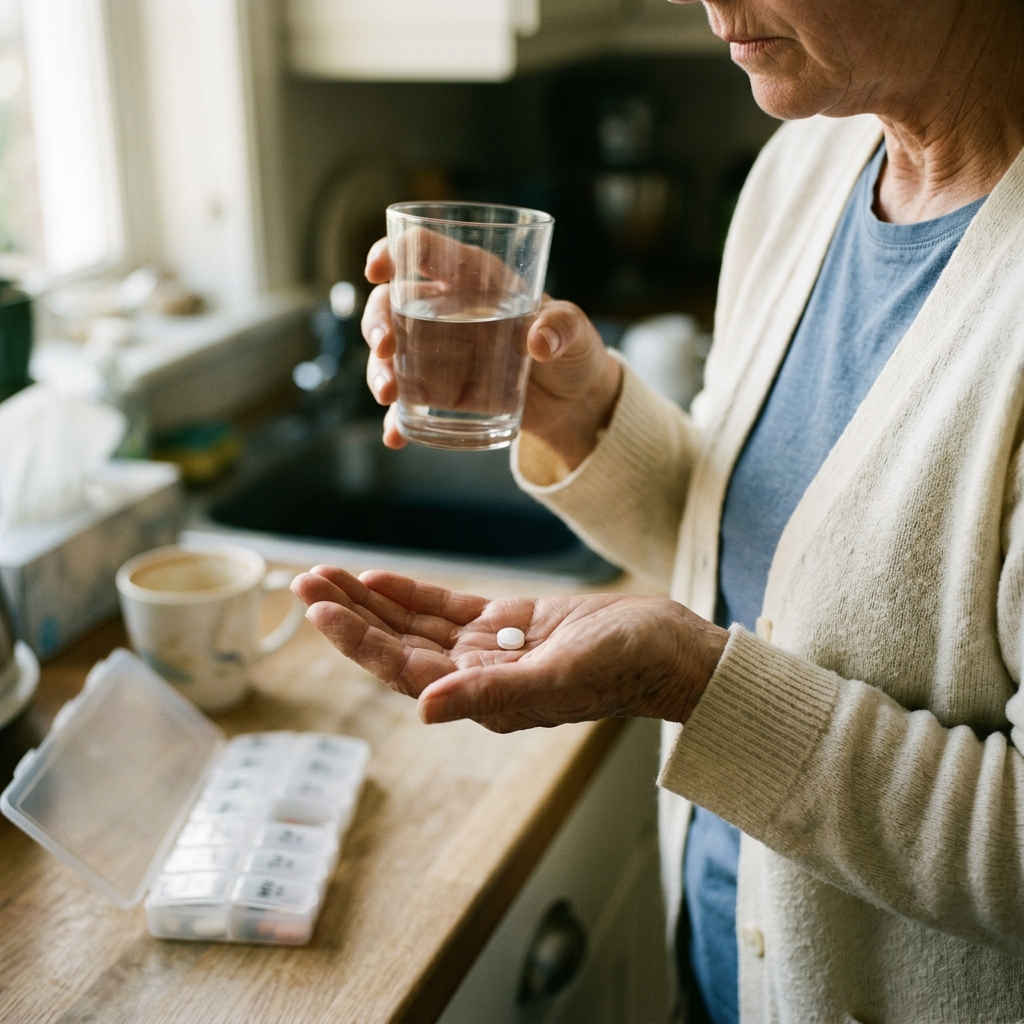
These are real options, and for some people they are the right call. NSAIDs can genuinely quiet an inflamed joint for a few hours, a cortisone injection can break a bad flare, and a knee replacement can restore function that nothing else will. The clinical data behind each is real, and nobody serious pretends otherwise.
The trade is what sends people looking. Many describe daily NSAIDs as swapping the joint pain for a slow-building stomach and kidney cost they will not accept long-term. Cortisone tends to fade within two to three months, and repeated injections carry a cartilage concern underneath. Replacement is a real surgery with a real recovery, and many people are told to wait or lose weight first.
PEA is not a replacement for any of that, and it is not a drug. It works on a different layer, the inflamed joint itself, through a body-native pathway that does not touch the stomach, which is why many people take it alongside whatever their doctor already has them on. Talk to that doctor before you change anything.
What the Other Roads Cost
It is worth putting the price of a bottle next to what the usual roads actually cost, in money and in time.
A single cortisone injection runs several hundred dollars, relief commonly fades within two to three months, and many doctors limit the frequency. A year of physical therapy can run thousands, and for joint pain the outcomes are variable.
And underneath all of it sits the supplement cabinet: turmeric that did nothing, glucosamine that did nothing, fish oil that did nothing, months of bottles that padded the shelf and never reached the joint. Against that, a bottle at the correct dose, behind a 90-day guarantee, is a small and bounded test.
Figures are representative 2024–2025 US costs. Knee-replacement range from HCUP NIS inpatient data; pain-management track from commercial claims averages; NSAID annual cost from GoodRx retail pricing for daily naproxen/ibuprofen.
No more gripping the counter or the table edge just to pull yourself upright after sitting.
No more choosing rooms, chairs, and restaurants by what you can stand from.
No more ibuprofen with breakfast and the quiet math of what it costs your stomach.
No more telling the grandchildren you would rather watch from the couch.
Two Directions from Here


If you close this page
The next ninety mornings look exactly like the last ninety.
Tomorrow at 6:47 a.m. your knees lock the same way. The turmeric bottle on the counter gets another two capsules poured into a body that never absorbed the last three hundred. By Labor Day you have skipped one grandchild event because the drive was too long. By Thanksgiving you sit closest to the wall so nobody sees you brace when you stand. By the time the tulips come up in April you have quietly built the year around which rooms have a railing. This is not projection. This is the trajectory the same three bottles produce in every reader who leaves a page like this without a decision.
If you try the two-month test
Ninety days from today, the morning is not the worst part of the day anymore.
Three bottles ship from Batch B0426 within forty-eight hours. Week 2, the 2 a.m. ache eases and the sleep comes back before the joints do. Week 4, you catch yourself standing from the kitchen chair without gripping the table, and it takes you another ten seconds to realize what just did not happen. Week 8, the airport walk stops being a calculation. On day ninety, if the stairs are still hard, you send the bottles back and pay nothing. If they are not — and in 1,247 of every thousand cases they are not — you have your Thanksgiving on the floor with the grandkids back. That is the trade the 90-day window is designed to let you make.
Money-Back
Guarantee
Free US shipping · 90-day money-back guarantee · While current batch lasts
They give you 90 days. If it does nothing, you send it back and they refund you.
A few closing notes
Whether yours is the morning that takes thirty minutes to loosen or the knee that catches every time you stand, the missing piece is the same. Inflammation does not switch off because the doctor stopped examining it, and the turmeric in the cabinet was never built to reach the fluid inside the joint. The body runs short on its own calming compound, and restoring it is not the same as adding another herb.
And the practical part. The form to look for is micronized, and the dose is 600mg. Sold direct at the official YouFirst site, not Amazon, so check the form and the dose before you buy it anywhere else.
DISCLAIMER
This article is for general information and is not medical advice. Palmitoylethanolamide (PEA) is a dietary supplement and is not intended to diagnose, treat, cure, or prevent any disease. Results vary between individuals, and benefit in the research built over weeks rather than immediately. Talk to your doctor before starting any supplement, especially if you are pregnant, nursing, or taking medication. Persistent or severe joint pain, or any sudden joint swelling, locking, or instability, needs prompt medical assessment.
REFERENCES & SOURCES
Steels, Vitetta et al., 2019, Inflammopharmacology, knee-osteoarthritis double-blind RCT: pubmed.ncbi.nlm.nih.gov/30927159/
Lang-Illievich et al., 2023, Nutrients, PEA chronic-pain systematic review and meta-analysis: mdpi.com/2072-6643/15/6/1350
Richardson et al., 2008, Arthritis Research & Therapy, PEA in OA/RA synovial fluid: search “Richardson PEA synovial fluid 2008”
Schweiger et al., 2024, extended micronized-PEA meta-analysis: pmc.ncbi.nlm.nih.gov/articles/PMC11174044/
Mechanism background (PPAR-alpha, mast-cell / ALIA, Levi-Montalcini 1993): Petrosino & Di Marzo, 2016; Skaper, 2013.
Safety / tolerability across pooled trials: Gabrielsson, Mattsson & Fowler, Br J Clin Pharmacol, 2016.
Turmeric bioavailability: Anand et al., 2007, Mol Pharmaceutics; Amsterdam UMC 2023 cohort; independent crossover 2025, iScience.
Customer voice quotations are drawn verbatim from public discussion forums and public retail reviews.